

Estonia · Baltic · History
History of Estonia
From ice-age shores to a digital republic — Estonia’s fight for sovereignty, told in one film.
Watch History of Estonia on YouTube@sagastube
Companion essay
Read the history of Estonia
Estonia is a small Baltic country of free-men’s assemblies and later of song, held for centuries by Danes, Germans, Swedes, and Russians, and twice forced to win a state back from Moscow. The story runs from Finno-Ugric shores to a republic on the Gulf of Finland.
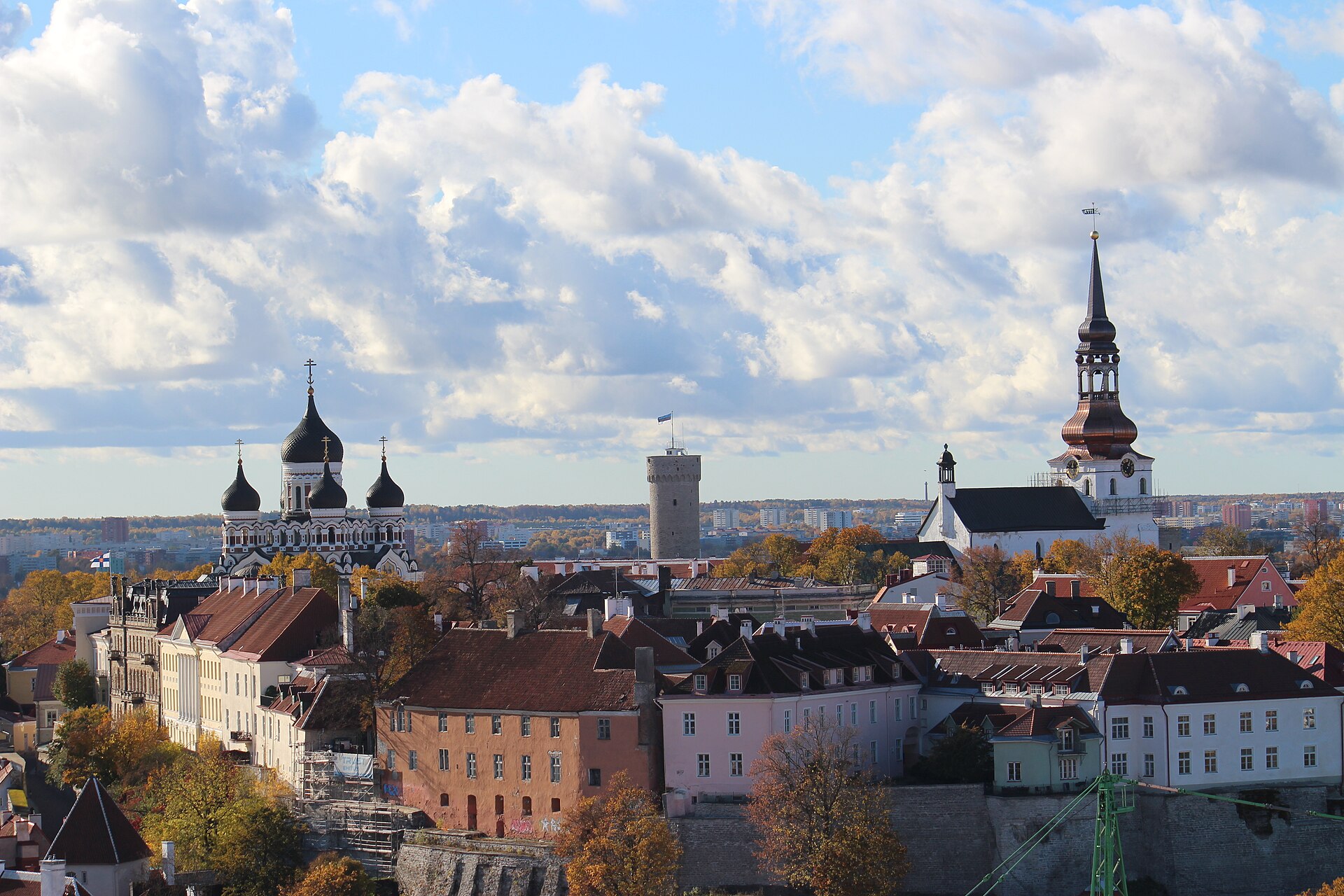
Tallinn’s old town, where church towers still share the skyline with a digital state.
Wikimedia Commons · File:Tallinn Old Town Skyline (52432521369).jpg.jpg) · Photo by William John Gauthier · CC BY-SA 2.0
Prehistory and the tribes
When the last ice pulled back, it left a shore that Finno-Ugric tribes would make their own. The Roman historian Tacitus, around 100 AD, is the first writer to mention Estonians — though he likely used the name as a catch-all for peoples around the Baltic. Those groups already traded, among others, with Rome.
Early Estonia was a country of regions, each with a local chieftain who sat in council with assemblies of free men. From the 9th century Vikings from the east began to pass through. From the 11th, Estonians sailed the other way, in trade and plunder toward Sweden and Denmark. In the 11th and 12th centuries Russians struck repeatedly in the southeast, including Tartu. German and Danish attacks in the same years took on a religious justification: the Estonians had not been baptised.
Crusaders
The Baltic became a crusading ground. In 1202 the German bishop Albert founded the Swordbrother Order in Riga. In 1217 a mixed army of German knights, Latvians, and Livonians broke the Estonians at Viljandi — German Fellin — and killed their leader Lembitu. The south passed under the Order and the Bishop of Riga.
To break the north, the Germans called in King Valdemar the Victorious of Denmark. He took that part of the country, including Tallinn — “the Danish city,” German Reval. The Danes did not colonise it. After several risings, the largest in 1343–1345, King Valdemar Atterdag sold northern Estonia to the Teutonic Order in 1346. The Swordbrothers had been folded into that Order in 1237.
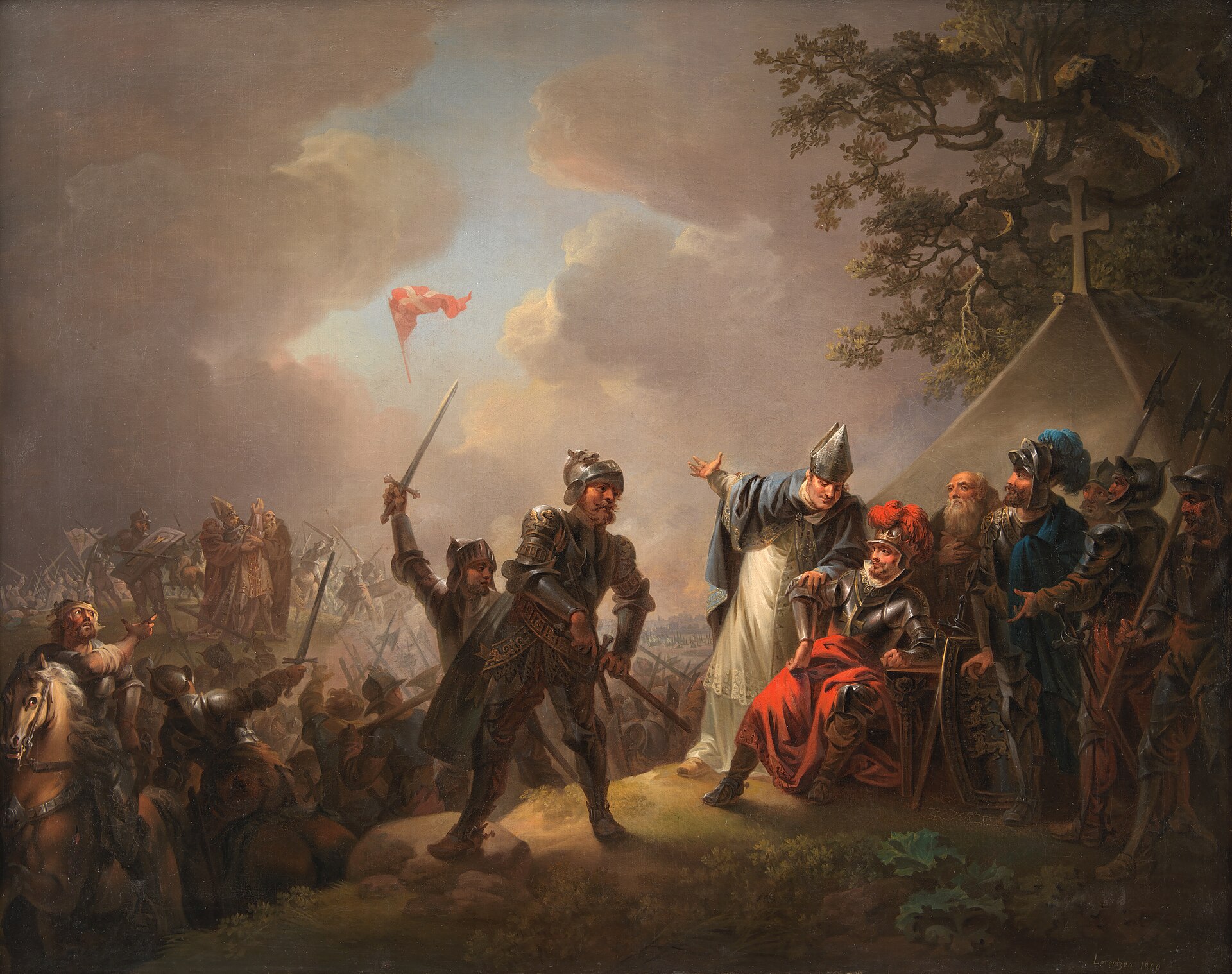
Christian August Lorentzen’s Dannebrog Falling from the Sky (1809): Valdemar’s battle at Lyndanisse, later Tallinn, in 1219.
Wikimedia Commons · File:CA Lorentzen, Dannebrog falder ned fra himlen under Volmerslaget ved Lyndanisse Tallin i Estland den 15 juni 1219, 1809, KMS274, Statens Museum for Kunst.jpg · Christian August Lorentzen · Public domain
The Germans ruled for centuries. Tallinn and Tartu joined the Hanseatic League and grew rich on the Russian trade. Estonian peasants kept their personal freedom at first, then slid into serfdom as labour dues grew heavier in the 16th and 17th centuries. The Reformation reached the Baltics from the 1520s and helped hollow out the Order’s state. Russia and the Polish–Lithuanian union pressed from without.
East of Estonia, Tsar Ivan III had taken Novgorod in 1471. He failed to seize Livonia — which then included southern Estonia — and in 1492 built Ivangorod directly opposite the Order’s Hermann Castle in Narva, across the river.
In 1558 Ivan IV the Terrible invaded Livonia and took Narva and Tartu. The Order’s state dissolved. The land was ravaged for years. Knights who wanted a Catholic Polish–Lithuanian alliance ran into Protestant Germans. Denmark bought the islands of Dagö (Hiiumaa) and Ösel (Saaremaa), and Wiek (Läänemaa) on the mainland, in 1559.
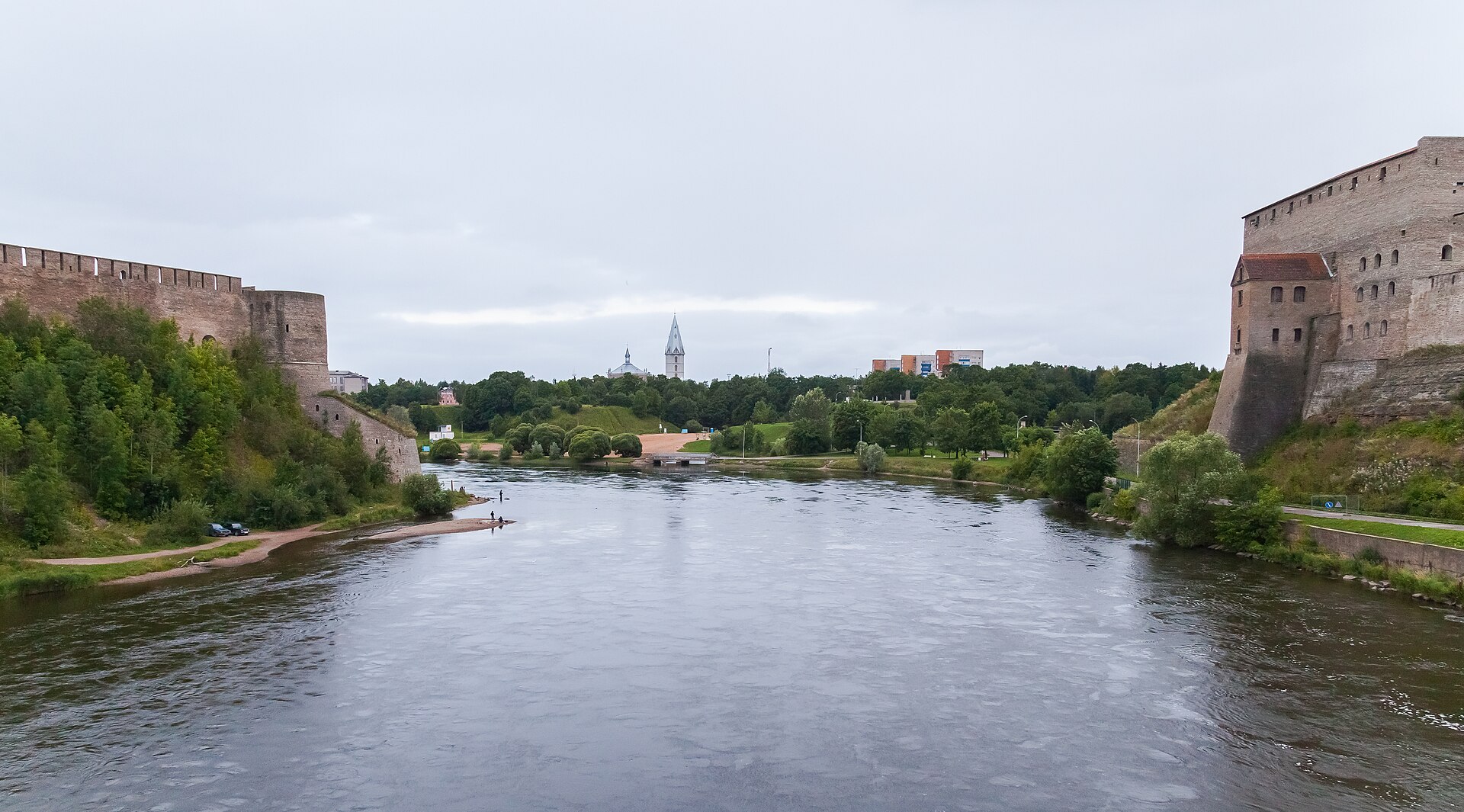
Hermann Castle in Narva, on the Estonian bank; Ivan III’s Ivangorod faces it across the river.
Wikimedia Commons · File:Río Narva entre Ivangorod y Narva, frontera Estonia-Rusia, 2012-08-10, DD 01.jpg · Photo by Diego Delso · CC BY-SA 3.0
The good old Swedish times
Swedish forces under Erik XIV took Tallinn in 1561. Swedish rule at first meant the north. The south, as part of Livonia, went to Poland–Lithuania. Ivan the Terrible had not finished with Estonia. Russians and Swedes fought until Sweden won at Narva in 1581, with a truce in 1583.
From 1558 to 1629 the country was a battlefield. During the Thirty Years’ War, Gustavus Adolphus took southern Estonia and Latvia by the Treaty of Altmark in 1629. Denmark ceded Ösel at Brömsebro in 1645. Dagö and Wiek had already passed to Sweden in 1583. The Swedish hold was then complete.
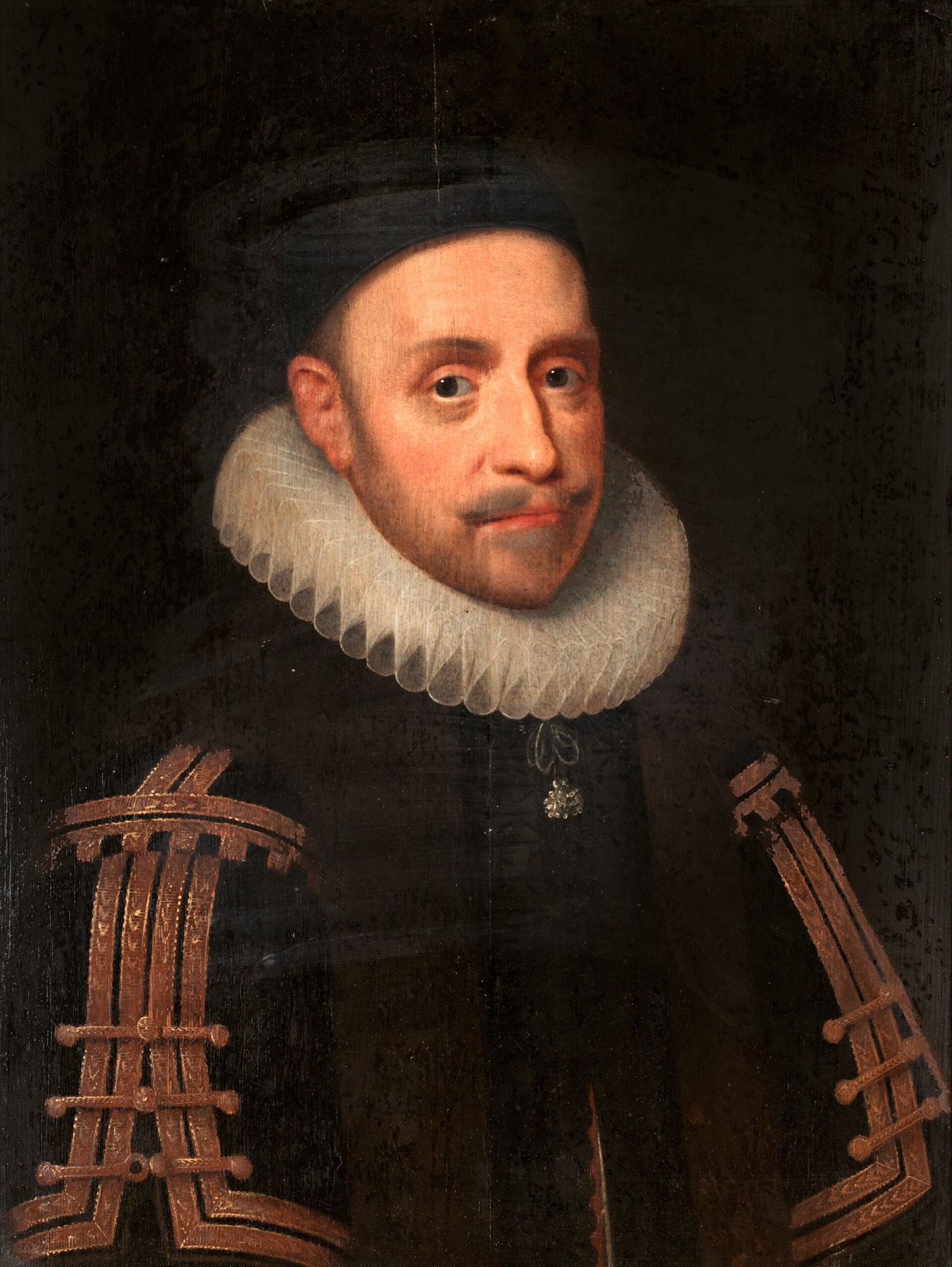
Gustavus Adolphus, the Swedish king who pulled southern Estonia into the realm during the Thirty Years’ War.
Wikimedia Commons · File:Jacob Hoefnagel (Attr.) - Portrait of king Gustavus Adolphus of Sweden.jpg_-_Portrait_of_king_Gustavus_Adolphus_of_Sweden.jpg) · Jacob Hoefnagel · Public domain
German stayed the language of government. The German nobility and the free cities kept their rights. Few Swedes immigrated, though some nobles took fiefs. Estonia fed Sweden with grain and paid into the Baltic trade. A large part of the Swedish conscript army was stationed here against Russia. Tallinn became the third city of the Swedish empire, after Stockholm and Riga.
In the 17th century the kings tried to curb the German nobility. Serf dues were made less arbitrary. Literacy was made compulsory. A university was founded at Tartu in 1632. The New Testament appeared in Estonian in 1686, and priests and officials were told to learn the language. How far that zeal went rose and fell with the monarch. The German nobility remained the local power. Even so, Estonian folk memory still calls the period “the good old Swedish times.”
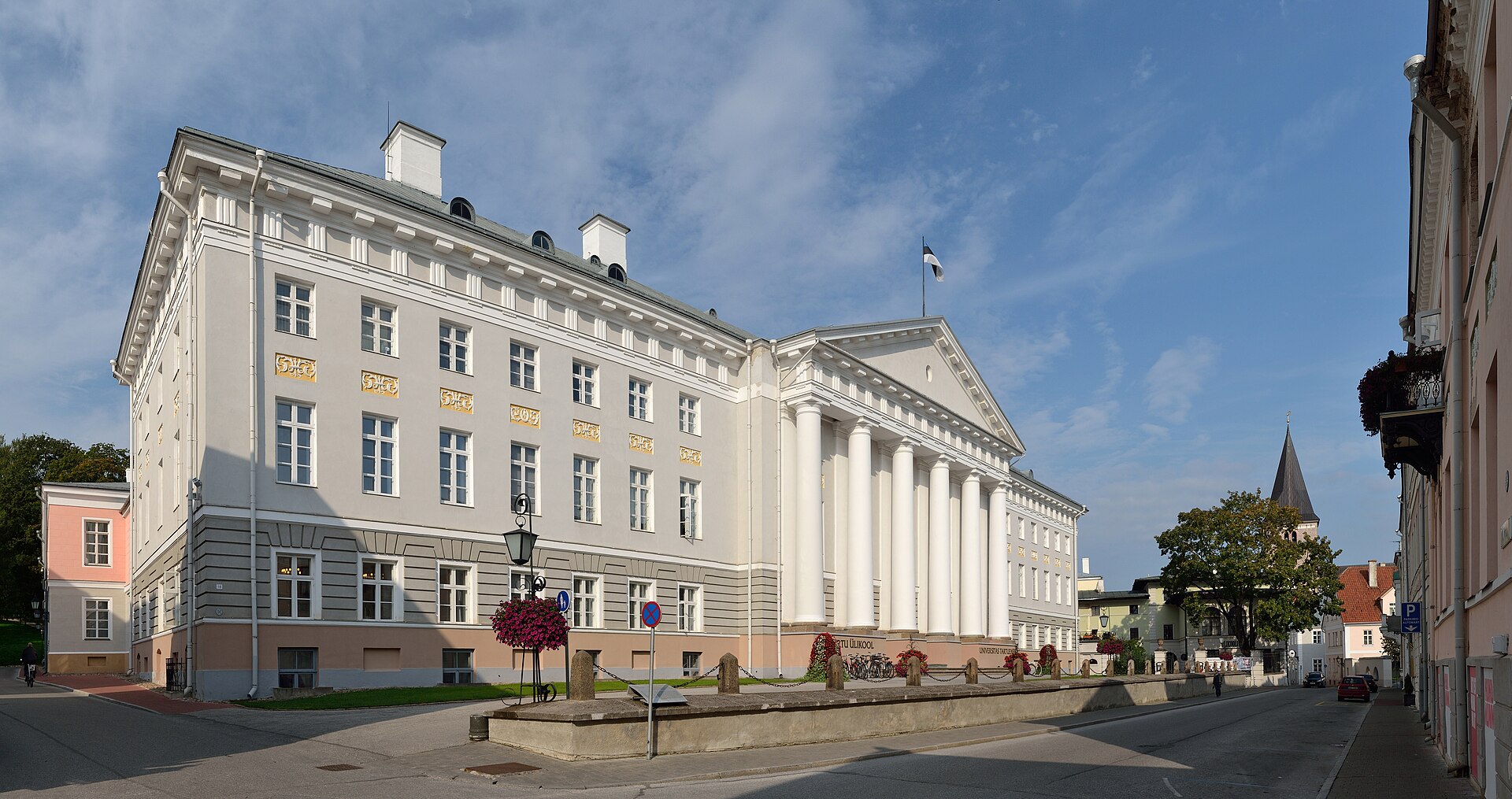
The main building of the University of Tartu, founded in 1632 as Academia Gustaviana.
Wikimedia Commons · File:Tartu Ülikooli peahoone 2012.jpg · Photo by Ivar Leidus · CC BY-SA 3.0 ee
The Great Northern War
Between 1700 and 1721 Estonia was hit by crop failure, plague, and armies. The civilian population shrank. In 1700 Charles XII beat the Tsar at Narva, then took his main force to Poland. The Russians overran the country behind him. In 1710 the last Swedish troops in Tallinn capitulated. The Treaty of Nystad in 1721 made the cession formal.
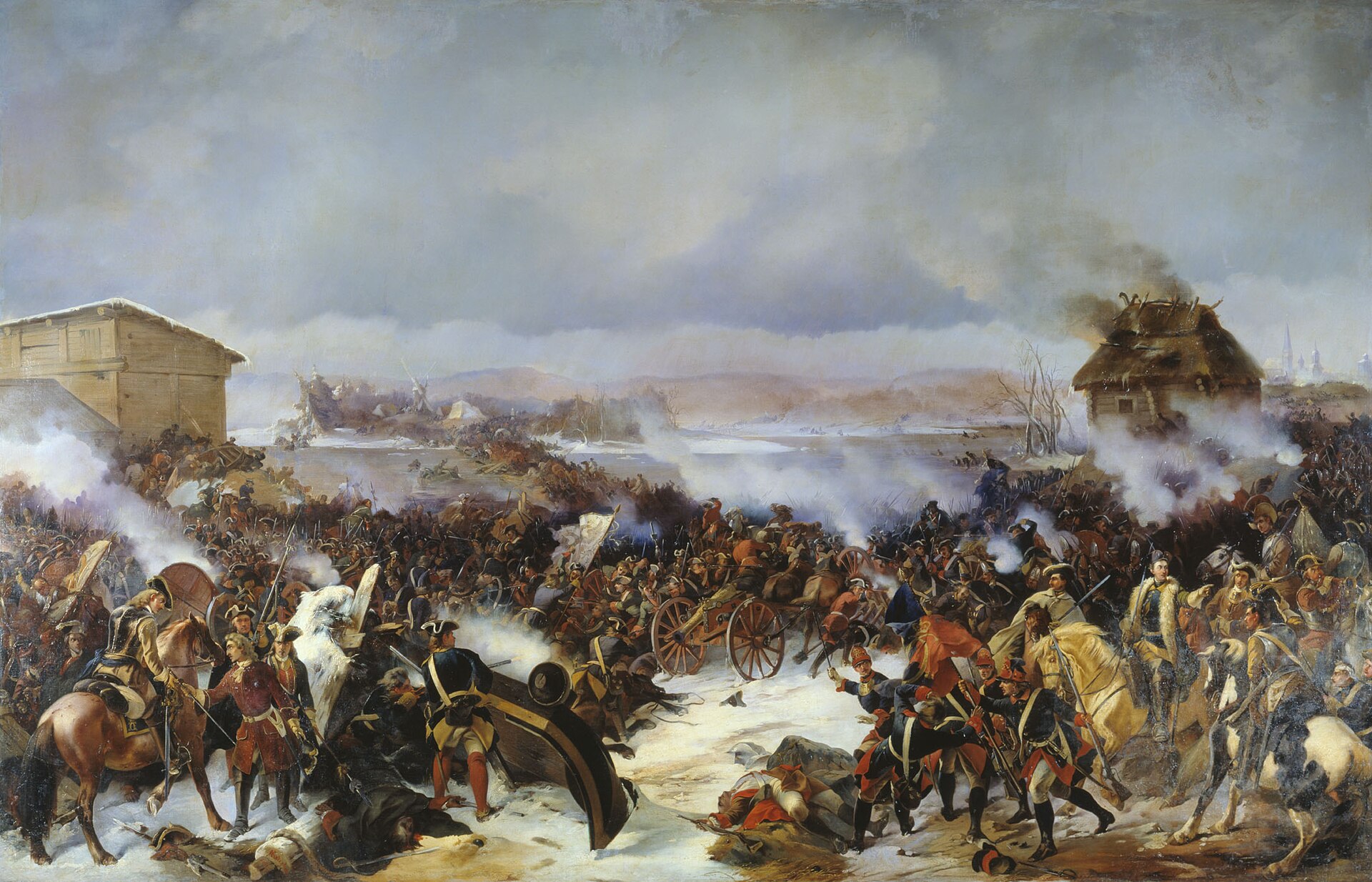
Alexander von Kotzebue’s Battle of Narva (1700): Charles XII’s victory, soon squandered when the war moved to Poland.
Wikimedia Commons · File:Battle of Narva 1700.JPG · Alexander von Kotzebue · Public domain
Under the tsars
In practice the new Russian Baltic provinces went on as self-governing noble republics under the Tsar. Young noblemen could now make careers in the Russian army or bureaucracy. Estonia was a governorate covering today’s north. The south belonged to Livonia.
Peace allowed rebuilding. Socially the peasants fared worse than under Sweden, because landowners had a freer hand with their serfs. There were risings, including one in 1782. Progressive nobles pushed St Petersburg to abolish serfdom in Estonia in 1816 and in Livonia in 1819. Emancipation came without land: rent and labour still sat in the landlord’s gift. Smaller risings through the 19th century were put down by Russian troops.
From the 1850s peasants won the right to buy land — at prices the landowner set — labour dues ended, and the landlords lost their courts. By the end of the century peasants owned 40 percent of the land. Peasant sons went to school. Estonians began to break the German hold on the towns. In Tallinn their share rose from 52 percent in 1867 to 89 percent in 1897. Railways from Russia to the Baltic ports, and industry at the century’s end, pulled people in from the countryside and from Russia. The cities lost their German character.
The University of Tartu, reopened in 1802, became a centre of national feeling. Illiteracy was all but gone by around 1900. From the 1880s a hard Russification lasted until 1905: Russian as the language of administration, courts and schools Russified, Tartu renamed Jurjev and switched to Russian in 1893. The campaign produced the opposite of what St Petersburg wanted. Jaan Tõnisson founded the first liberal party in Tartu. In Tallinn the leading figure was Konstantin Päts.
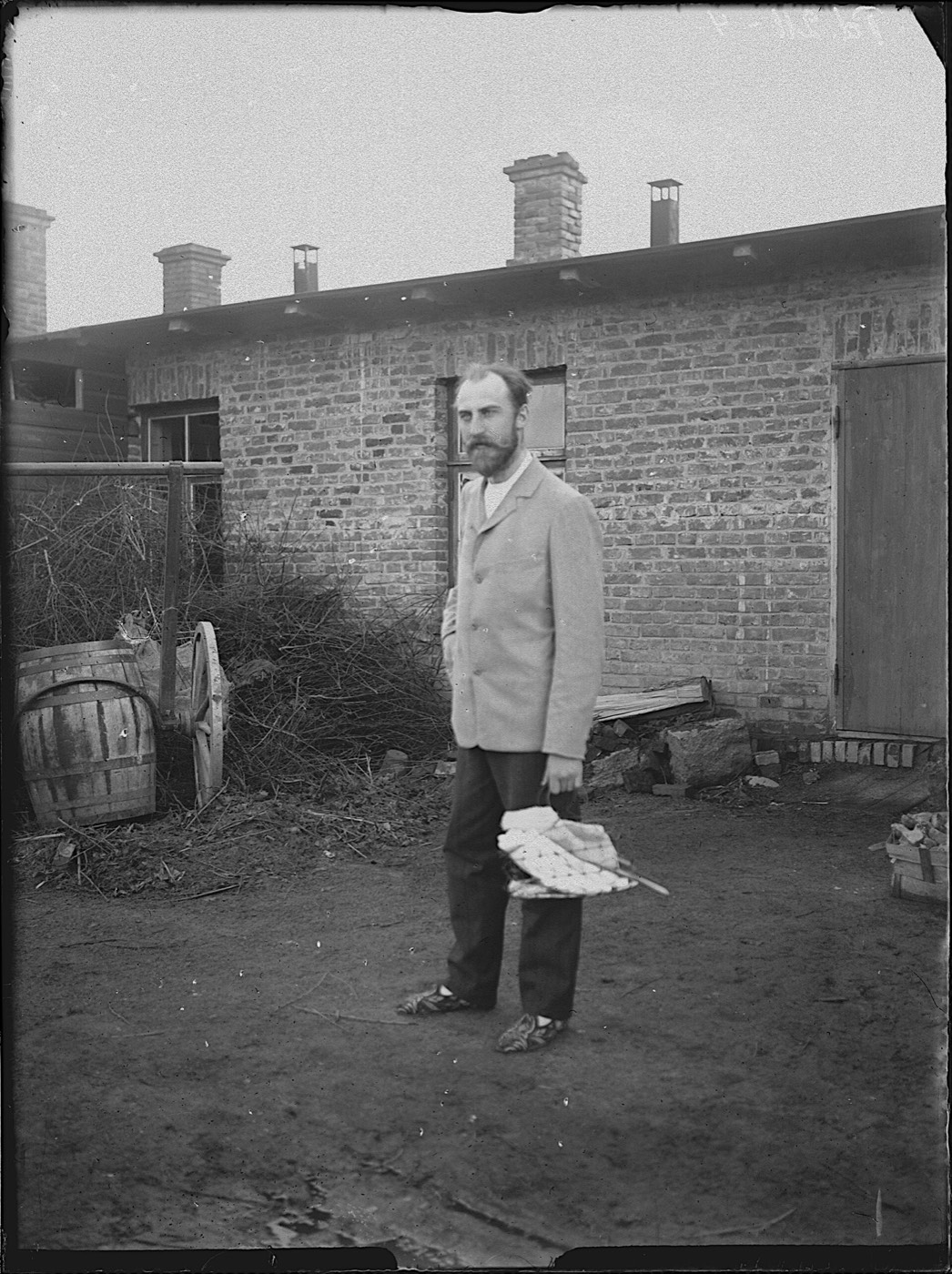
Jaan Tõnisson in 1908, a voice of the national movement in Tartu.
Wikimedia Commons · File:Jaan Tõnisson, 1908.jpg · Aleksander Eisenschmidt · Public domain
The 1905 revolution in Russia spread here. Parties demanded autonomy. A workers’ demonstration in Tallinn was shot down; 60 died. In the countryside German manors and vicarages were looted and burned. More than 300 Estonians were shot before it ended. After 1905 Estonians sat in the new State Duma, and private schools in Estonian were allowed.
A state, then a war for it
The revolutions of 1917 ended Russian rule. After March, every party demanded internal autonomy. In April the Provisional Government in Petrograd let the province of Estonia, northern Livonia, and the islands become one province, run by a commissioner and an elected council, the Maapäev. The German nobility objected and was ignored. The council was elected in June. In September some spoke of independence in union with the other Baltic and Scandinavian countries; the majority still wanted self-government inside a Russian federation.
After the Bolshevik coup in Petrograd in November 1917, the non-Bolshevik majority on the Maapäev chose full independence. On 28 November it declared itself the highest authority in the country. Soviets had already formed in the cities, where Russian workers were many. The Bolsheviks took those soviets as they had in Russia, and in November a military committee seized strategic points in Tallinn — a first Estonian Soviet republic that did not hold the whole country. Shortly after the Maapäev prepared independence, Soviet power in Tallinn dispersed it.
In February 1918 elections for a constituent assembly were annulled when the Bolsheviks saw they would lose. Revolutionary units confiscated gentry land and terrorised “class enemies,” social democrats included. Many politicians hid or fled. German troops, in Estonia since September 1917, had most of the country by February 1918. The Bolsheviks fled Tallinn. In the brief gap, on 24 February 1918, a liberation committee of the Maapäev’s presidium declared Estonia independent and named a provisional government under Konstantin Päts. The Germans occupied Tallinn the next day.
Brest-Litovsk, on 3 March 1918, left Estonia under temporary German occupation. An additional agreement on 27 August forced the Soviet government to drop its claims. When Germany collapsed that autumn, Estonia stood open to a Soviet offensive. Narva fell on 29 November; the same day an “Estonian Workers’ Commune” under Jaan Anvelt was proclaimed and recognised by Moscow a week later. The Russian drive continued in December and was thrown back in January 1919. A British naval squadron and some 2,700 Finnish volunteers made the difference.
By 24 February 1919, a year after the declaration, the provisional government held the whole country. A communist rising on Saaremaa in February was crushed in days. Soviet Russia recognised Estonia in the Tartu Peace Treaty of 2 February 1920 — the first government to do so.
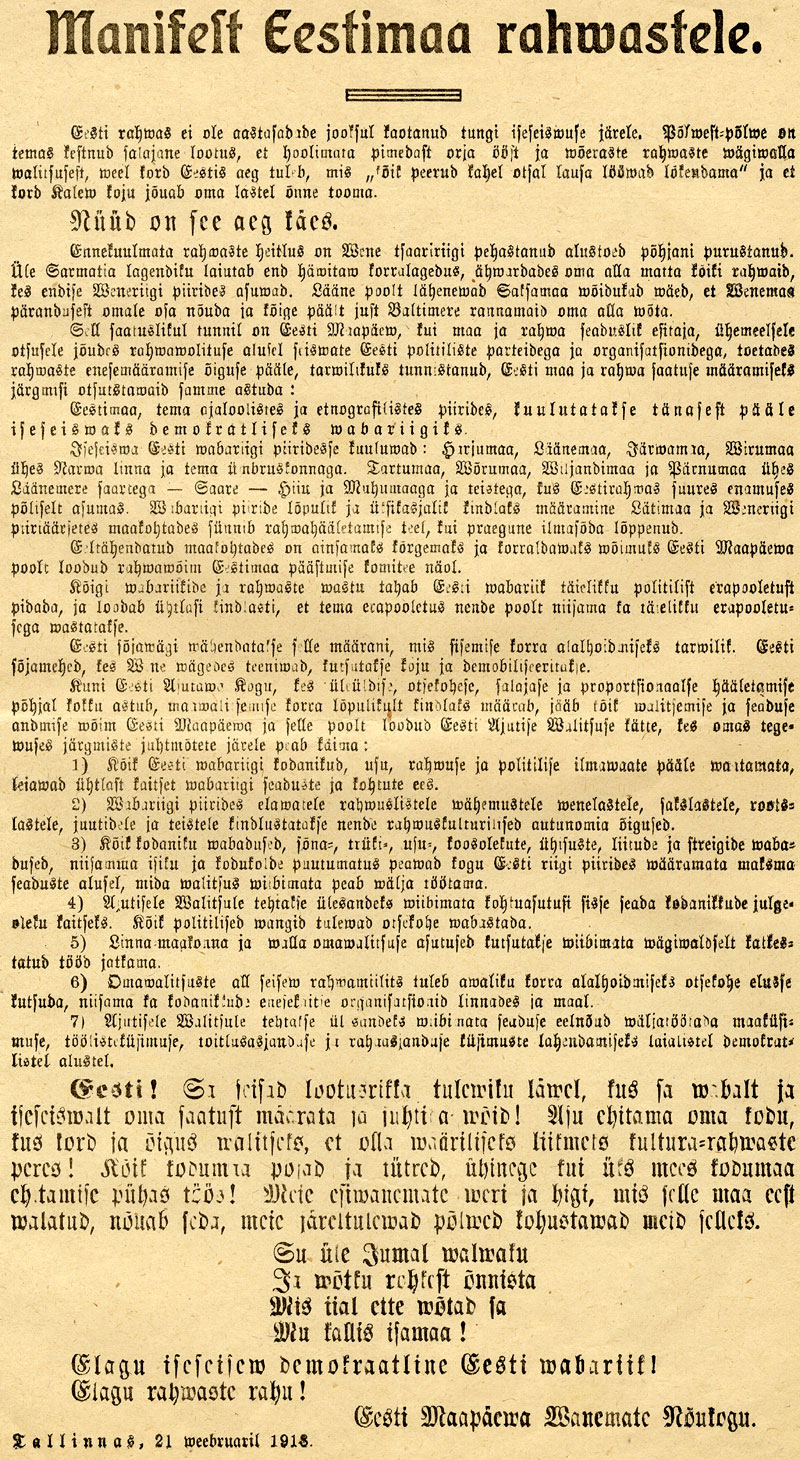
The Manifesto to All Peoples of Estonia, 24 February 1918.
Wikimedia Commons · File:Estonian Declaration of Independence.jpg · The Elders of the Estonian National Council · Public domain
The first republic
The new state inherited wreckage and a vanished Russian market, then rebuilt. Britain was the largest trading partner, then Germany from 1937. A radical land reform in 1919 broke the German landed aristocracy: farms doubled, more than 50,000 new ones were created, forests were nationalised, and later compensation to the old owners was almost symbolic. Culture flourished. National minorities received educational rights.
In April 1919 a Constituent Assembly was elected. On 15 June 1920 it adopted a constitution: a parliamentary republic, a unicameral Riigikogu, proportional representation, three-year terms, votes for women. There was no separate head of state. The prime minister was “State Elder,” Riigivanem. No electoral threshold meant a swarm of parties and frequent changes of government.
The main camps were the conservative Farmers’ Party, the liberal People’s Party, and the Social Democrats (from 1925 the Socialist Workers’ Party). The leading names were Päts, Tõnisson, and August Rei. The Communist Party took 10 percent in 1923 and launched an armed rising in Tallinn in 1924. It was crushed; dozens died in the fighting and in summary executions. The party was banned.
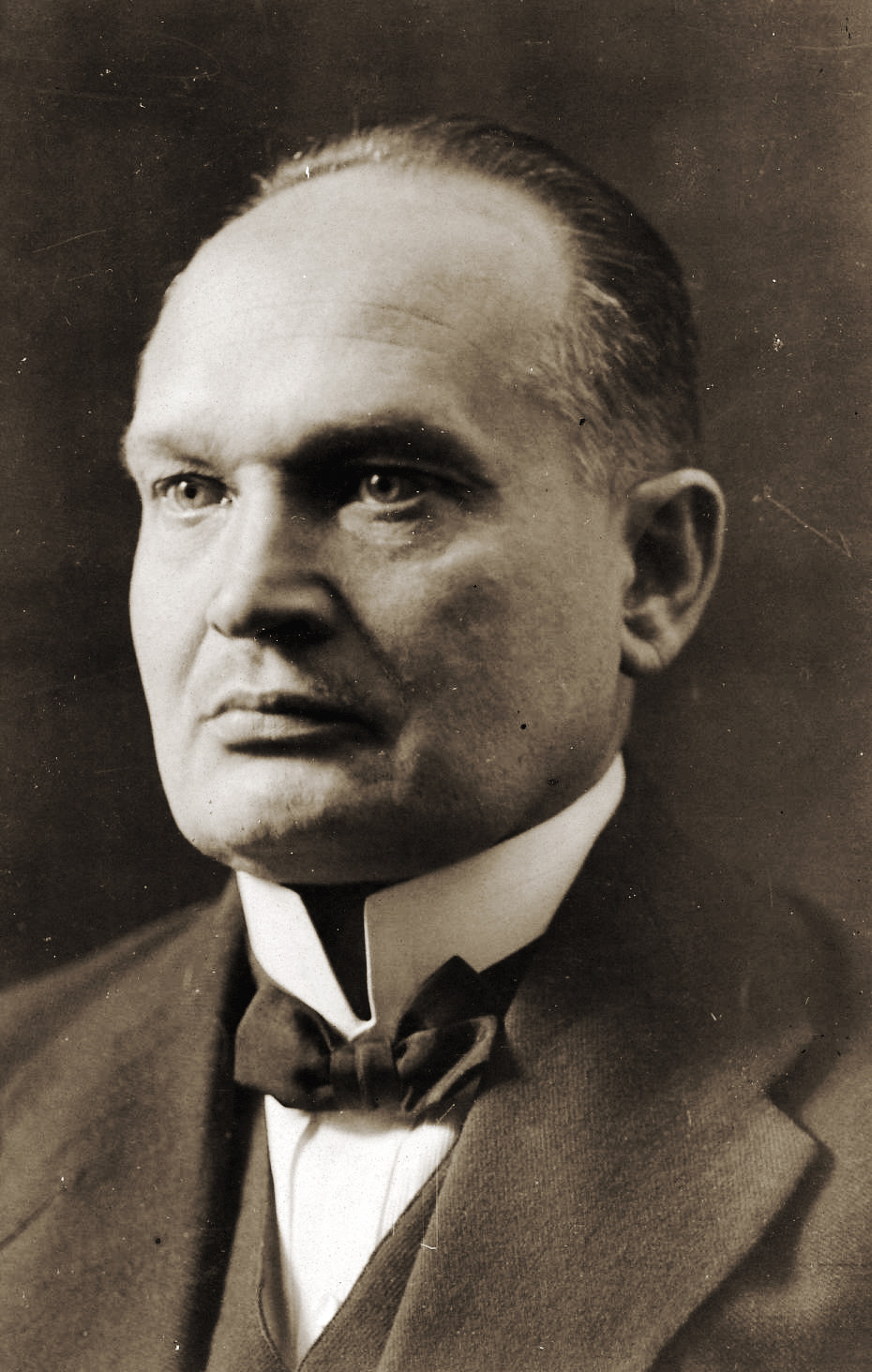
Konstantin Päts, State Elder and later president — the central figure of the first republic, for better and worse.
Wikimedia Commons · File:Konstantin Päts.jpg · Unknown photographer · Public domain
The slump around 1930 hit hard. The League of Freedom Fighters — volunteers from the War of Independence who drifted toward an anti-parliamentary, Finnish Lapua-style fascism — won a 1933 referendum for a strong presidency. In March 1934 Prime Minister Päts declared a state of emergency and staged a coup with officers and other party leaders. The League was banned; the next year so were the other parties, replaced by a “government party,” the Patriotic League. The dictatorship was relatively mild. A League coup attempt in 1935 failed. A 1938 constitution gave the president more power and created a bicameral National Assembly. Päts became president. There were signs in 1938–1939 that he meant to ease back toward democracy. The coming war closed that door.
Estonia joined the League of Nations in 1921 and tried to stay neutral. The West and the Nordics had little appetite for Baltic security. Finland and Sweden would not be drawn in. A Baltic pact with Poland foundered on Vilnius. Estonia and Latvia signed a defence agreement in 1923; Lithuania joined a looser “Baltic Entente” in 1934. Non-aggression pacts with the Soviet Union in 1932 and Germany in 1939 did not bind either power. A secret annex to the German–Soviet pact of 23 August 1939 put Estonia in the Soviet sphere.
Occupations
After the war began in September 1939, Moscow demanded a military alliance and bases. Estonia signed on 28 September. Latvia and Lithuania were forced into the same. Molotov still spoke of sovereignty. Germany prepared the ground by moving the Baltic Germans — seven centuries in the country — “home.”
When the Winter War began on 30 November 1939, the Soviets took still more bases in Estonia. The Finnish peace in March 1940 gave Tallinn a false hope.
On 16 June 1940 Estonia and Latvia received an eight-hour ultimatum: a larger occupation and a government that would “honestly” implement the assistance pact. Lithuania had already yielded on the 14th. On 17 June the invasion began. Under pressure and street demonstrations, Päts named Johannes Vares-Barbarus prime minister. The Communist Party was legalised, the constitution broken, opposition barred from a 14–15 July election. The official result was 92.9 percent for the “Workers’ Bloc.” On 21 July the new parliament proclaimed a Soviet republic; the next day it asked to join the USSR. On 6 August Moscow incorporated Estonia. Päts was deported in July, before the annexation, and died in Soviet captivity in 1956. On 14 June 1941 more than 10,000 people were sent to Siberia in a single wave.
Germany attacked the Soviet Union on 22 June 1941 and was welcomed at first as a liberator. That welcome did not last. The Baltics and western Belarus were folded into Ostland under Hinrich Lohse; the Reich minister for the occupied east was Alfred Rosenberg, born in Tallinn. In three years the Germans executed several thousand Estonians. Of about 5,000 Estonian Jews, some 4,500 were killed. Cohorts of young men were taken for labour; some went into the Waffen-SS. Thousands fled to Finland and chose to fight the Soviets there rather than for Germany.
After Stalingrad an Estonian National Committee formed on 23 March 1944, hoping to restore independence before the Red Army arrived. With Päts in captivity, the last lawful prime minister, Jüri Uluots, assumed presidential powers and in September named Otto Tief to lead a provisional government. Estonian units helped delay the Soviets on the Narva. Tief’s government redeclared independence on 20 September 1944. Soviet forces entered Tallinn on the 22nd. By the end of November the country was occupied again. More than 60,000 people fled, about half to Sweden. Many died at sea. Sweden later extradited some to the Soviet Union. Further deportations followed in 1945–1946, and in 1949, with collectivization, tens of thousands more.
The second Soviet night
In 1950–1951 local Estonian communists were purged in favour of men raised in Russia, or of Russians. The economy was wired into the Soviet plan: industry, Russian immigration, rapid urbanisation, collectivized farms. Living standards were higher than the Union average, improved into the mid-1970s, then stagnated and fell in the 1980s.
Isolation eased a little in the 1960s. Ferries to Finland began. Finnish television reached the north. Estonian-born communists took more of the party and state. From the late 1970s Russification of culture returned, and so did Russian immigrants. In 1980 forty prominent intellectuals signed an open letter against it. That autumn there were student protests and a factory strike in Tartu. Dissidents were arrested through the 1980s; among them Mart Niklus and Jüri Kukk, who died in a camp in Vologda in 1981.
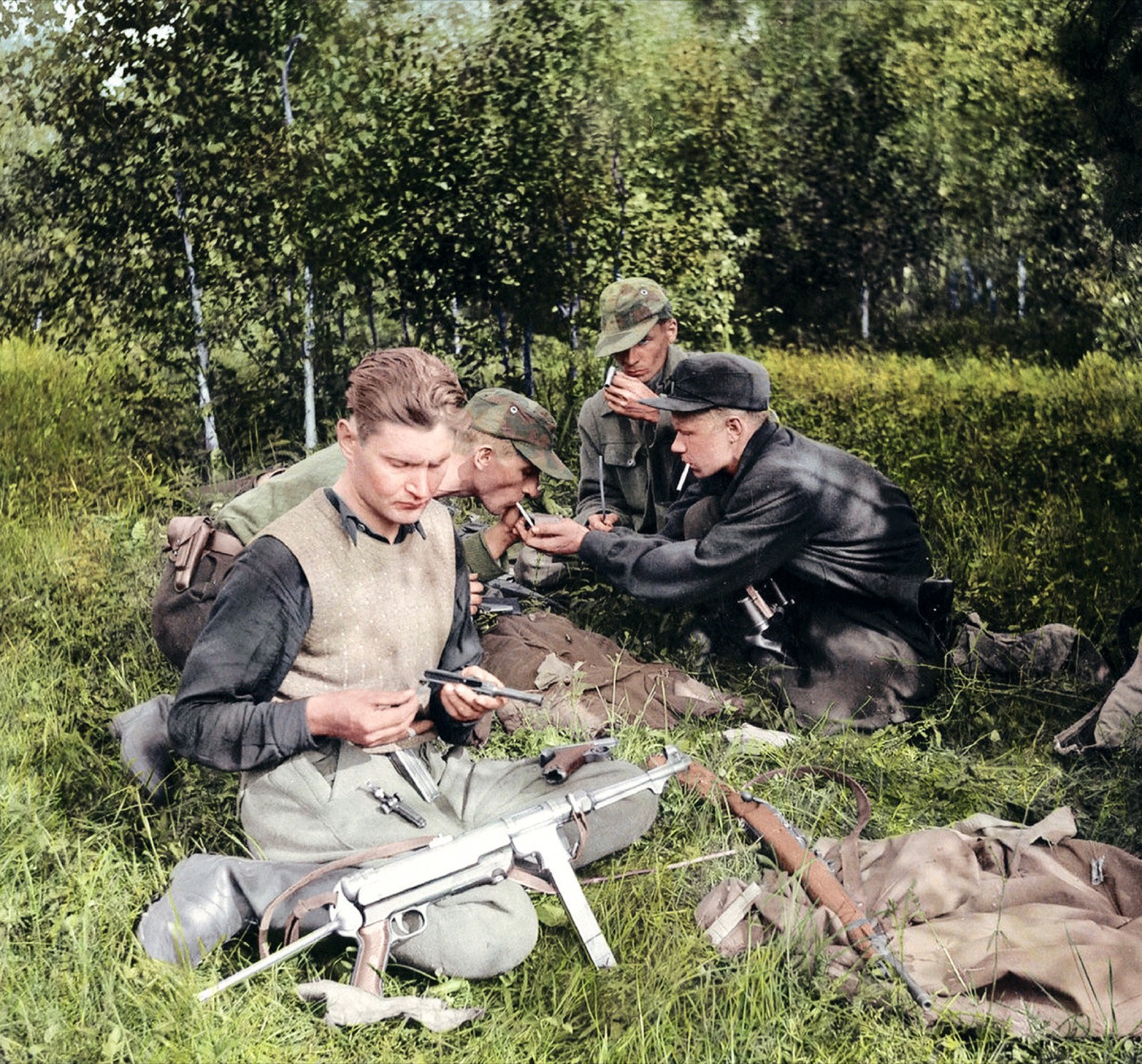
Forest Brothers after a shooting exercise in Veskiaru, Järva County, 1953 — the war after the war.
Wikimedia Commons · File:Estonian forest brothers relaxing and cleaning their guns after a shooting exercise in Veskiaru, Järva County, Estonia, 1953. (47953893422).jpg.jpg) · Photo via Julius Jääskeläinen · CC BY 2.0
The Singing Revolution
Gorbachev’s perestroika opened a door. The first crowds, in 1987, gathered over the environment; they soon gathered over the nation. The Estonian Heritage Society was founded that year. By 1989 Estonians were only 62 percent of the population. The deportations and killings of the 1940s came back into public speech.
A Popular Front for Perestroika formed in 1988, at first to back Gorbachev, then to push for independence. That summer hundreds of thousands sang. The Baltic independence movements took their name from those nights: the Singing Revolution.
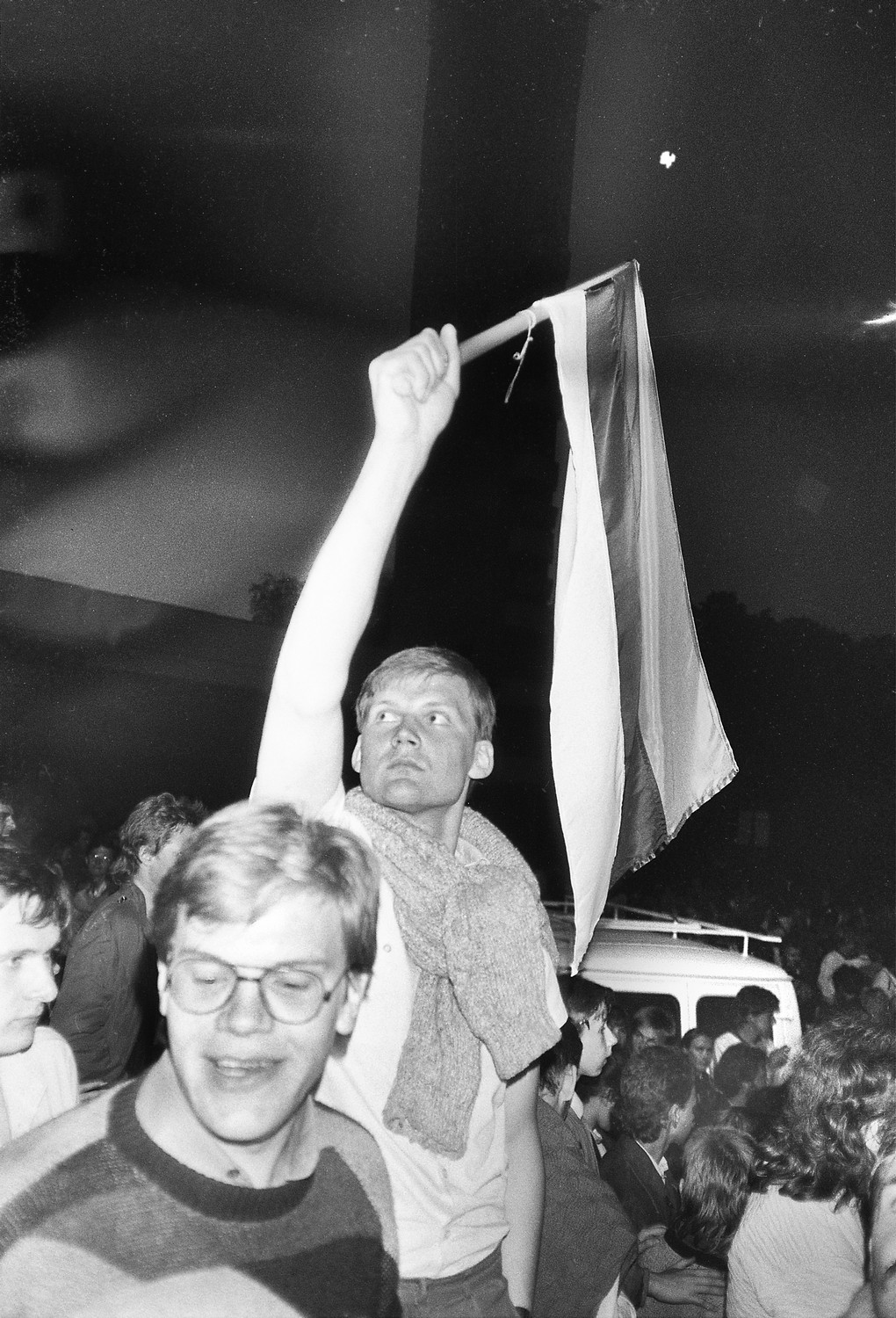
Night song festival, 1988 — the Singing Revolution in the open air.
Wikimedia Commons · File:Öised laulupeod 88 (51).jpg.jpg) · Photo by Jaan Künnap · CC BY-SA 4.0
A rally of 150,000 in Tallinn in June 1988 helped remove the hardline party boss Karl Vaino. Vaino Väljas replaced him and drifted toward the opposition. Arnold Rüütel, chairman of the Supreme Soviet from 1983 to 1992, did the same. On 16 November 1988 Estonia’s Supreme Soviet declared that Estonian law outranked Soviet law — the first such move in the Baltics. Moscow called it unconstitutional. A language law in January 1989 made Estonian official and required it for many public jobs. The Russian minority answered with Interfront in March.
On 23 August 1989, fifty years after the Molotov–Ribbentrop Pact, some two million people joined hands from Vilnius to Tallinn. In November the Supreme Council declared the Soviet annexation illegal. In the first free elections, on 18 March 1990, independence supporters took a two-thirds majority. Edgar Savisaar became prime minister. Radical nationalists, unwilling to trust a body descended from the old Supreme Soviet, organised an alternative Estonian Congress for pre-1940 citizens and their descendants. It met in March 1990 and then lost steam; many feared it would provoke Moscow.
In March 1991 Estonia boycotted the Soviet referendum on a new union treaty and held its own: 78 percent for independence. Estonians were 62 percent of the population, so many from the minorities voted yes. The failed coup against Gorbachev on 19–21 August 1991 opened the last door. On 20 August the Supreme Council declared full independence. Recognition followed; Soviet recognition came on 6 September. The Baltic states entered the UN and the CSCE. A new constitution, approved by referendum, took effect on 3 July 1992.
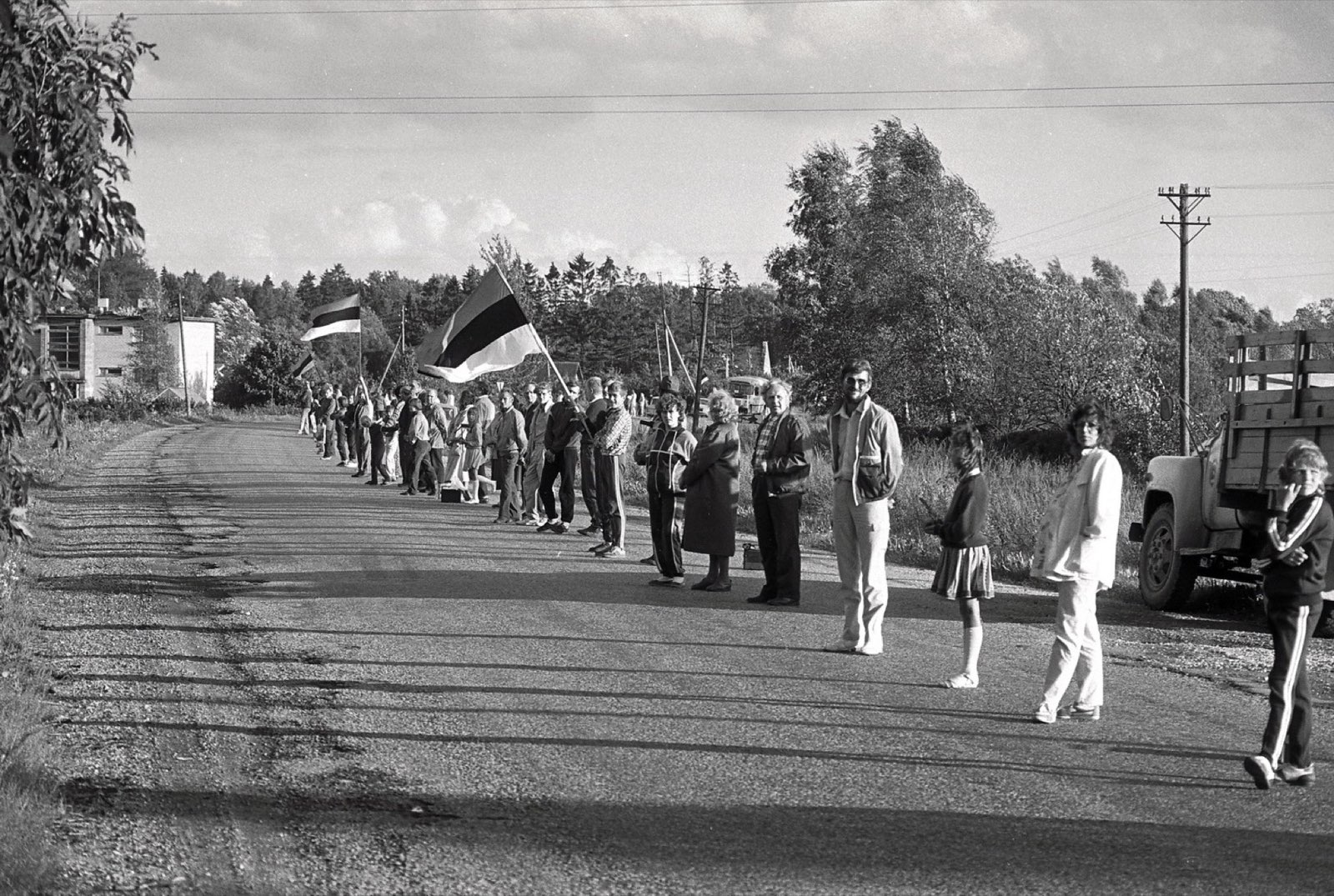
The Baltic Way in Estonia, 23 August 1989: a human chain from Vilnius to Tallinn.
Wikimedia Commons · File:Balti kett 23.jpg · Photo by Jaan Künnap · CC BY-SA 4.0
After the empire
There was no blueprint for leaving a planned economy, or for living with the demographic map the occupation had drawn. Factories closed. Eastern markets collapsed. In January 1992 Savisaar resigned. Tiit Vähi’s caretaker government, with Siim Kallas at the central bank, reintroduced the kroon in June 1992 — against World Bank and IMF advice, first among the former Soviet republics — and pegged it to the German mark. The black market and the inflation began to give way. Goods returned to the shelves.
The September 1992 election sent Lennart Meri to the presidency and, at thirty-two, the historian Mart Laar to the premiership. Laar privatised, freed prices, cut farm subsidies, and in 1994 introduced Europe’s first flat income tax, 26 percent. Farmers and pensioners paid first. Unemployment, corruption, and organised crime rose. Life expectancy and output fell. Inflation in 1993 was 90 percent. By 1994 the shock had begun to work.
That September the passenger ferry M/S Estonia sank on the way from Tallinn to Stockholm. 852 people died.
Citizenship was restored on the 1938 law: automatic for 1940 citizens and their descendants. About a third of the country had to naturalise — an Estonian language test, a grasp of the constitution. Moscow called it a violation of Russians’ rights and, for a time, tied it to the withdrawal of some 35,000 Soviet troops. On 26 July 1994 Boris Yeltsin and Lennart Meri agreed the rest would leave by 31 August. Retired personnel could stay with social support; Paldiski’s submarine specialists until September 1995.
A border treaty was harder. The 1920 Tartu peace had fixed a line; in 1944 Moscow had shifted slices around Ivangorod (Jaanilinn) and Pechory (Petseri) into the Russian SFSR. Estonia did not expect the land back, but wanted Tartu named in a new treaty. Russia refused, then withdrew ratification when the Riigikogu added the reference anyway.
The Orthodox Church split on the same fault line. The Estonian Apostolic Church under Constantinople had gone into Swedish exile; Soviet parishes had been folded into Moscow. After 1991, 53 of 84 parishes wanted Constantinople again. When Constantinople recognised the exile church in February 1996, Moscow broke with the mother see for less than three months. Both now operate. Moscow keeps the Alexander Nevsky Cathedral in Tallinn’s old town for a symbolic euro a year.
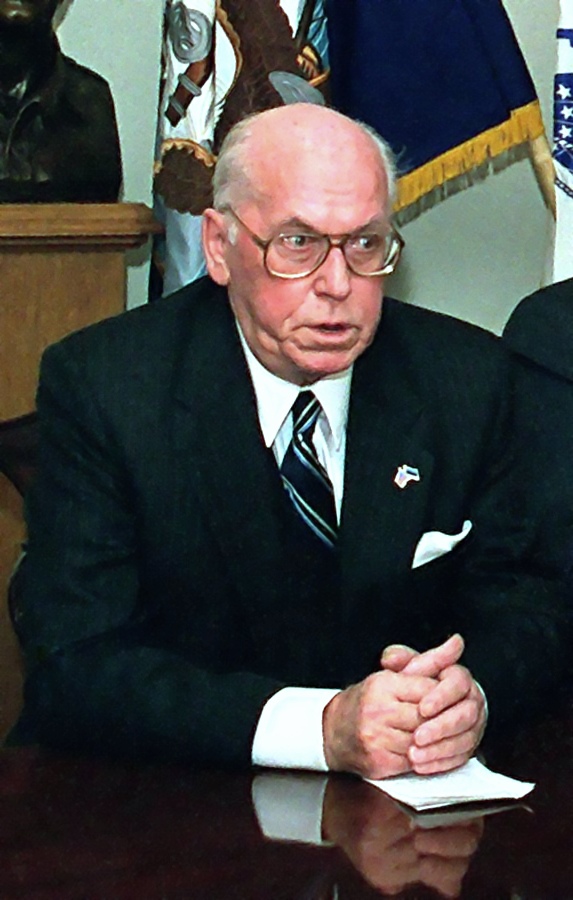
Lennart Meri in 1998, the writer-diplomat who rebuilt the foreign service and saw the Russian troops out.
Wikimedia Commons · File:Lennart Meri 1998.jpg · Helene C. Stikkel · Public domain
On a clear day Finland is visible across the gulf. In the Soviet years that also meant Finnish television — a private window the rest of the Union did not have. The national anthems share a melody. Sweden, with the United States, helped midwife the troop withdrawal. Estonia tried to sit with the Nordics; the Nordic Council never took the Baltics as full members. After Finland and Sweden joined the EU in 1995, Tallinn’s gaze shifted to Brussels and to NATO.
Neutrality had failed once. Partnership for Peace came in 1994; the 1999 round of NATO enlargement passed Estonia by; an invitation came in 2002. EU talks ran from 1998 to late 2002. A 1998 crash in Asia and Russia bankrupted firms that still sold east; they turned toward the Union. Paperless cabinet meetings began in 2000. Municipal e-voting in 2005, parliamentary e-voting in 2007 — first in the world.
In September 2003, 66.9 percent voted for the EU. There was no NATO referendum. Estonia joined NATO on 29 March 2004 and the EU on 1 May — with Latvia and Lithuania, the first former Soviet republics in both.
After the flags
Siim Kallas went to the European Commission the day Estonia entered the Union. Labour moved to Finland. Schengen came in December 2007. Andrus Ansip was prime minister for nearly nine years from 2005; Toomas Hendrik Ilves was president from 2006 to 2016. Growth in 2005 and 2006 ran at 10–12 percent, unmatched in the EU.
In April 2007 the authorities moved a Soviet war monument — the Bronze Soldier — from central Tallinn to a military cemetery. Ethnic Russians, fed by Russian television, rioted. Shops were looted. Hundreds were arrested; one person died in a fight between demonstrators. State television in Moscow implied a police killing and a desecrated grave. Government and media websites were hit by hackers linked to Russia. In Moscow, Kremlin-backed crowds went after the Estonian and Swedish ambassadors. The crisis faded when the Estonian ambassador left for a holiday.
The 2008 crash cut deep; austerity brought the country back. OECD membership came in 2010, the euro on 1 January 2011. EU-LISA, the agency that runs the Union’s big asylum and border IT systems, put its headquarters in Tallinn. Skype and Wise (once TransferWise) grew out of Estonia. In the 2018 PISA tests, Estonian fifteen-year-olds led Europe in reading, science, and mathematics.
By 2015 Estonia was among the NATO members spending at least 2 percent of GDP on defence. After Crimea in 2014 the Alliance thickened its presence in the Baltics and Poland. Narva and Ida-Viru County, more than 70 percent ethnic Russian and sitting on the oil shale, remain the place where that anxiety is felt. In 2021 a little over a thousand NATO soldiers, mostly British and Danish, were at Tapa.
Kersti Kaljulaid, elected in 2016, was the first woman president. With her in office Estonia sat as a non-permanent member of the UN Security Council in 2020–2021. When Kaja Kallas became the first woman prime minister on 26 January 2021, the country had women in both offices at once.
The country now is a small, wired republic — paperless cabinets, online voting, Skype and Wise — with Finnish television still in living memory and a NATO battalion at Tapa. It also lives with the demographic map the occupation left behind: Narva looks across to Russia, and a third of the people had to naturalise into the restored state.
Continue on the map
Related films
Lithuania · Baltic
History of Lithuania
From ancient pagan roots to Europe’s largest medieval state — and the long fight back to independence.
Finland · Nordic
History of Finland
Lakes, two crowns, and a republic forged in winter war — the history of Finland.
Sweden · Nordic
History of Sweden
Vikings, Vasa, and a great power that learned to live without an empire.
Norway · Nordic
History of Norway
Fjords, kings, occupation, and oil — the history of Norway.