

Lithuania · Baltic · History
History of Lithuania
From ancient pagan roots to Europe’s largest medieval state — and the long fight back to independence.
Watch History of Lithuania on YouTube@sagastube
Companion essay
Read the history of Lithuania
Lithuania is a country cut by crusading knights and, later, by partisan war — a place where the old religion and Christian spires still share a skyline. Its history runs from the receding ice to a republic on the Baltic.
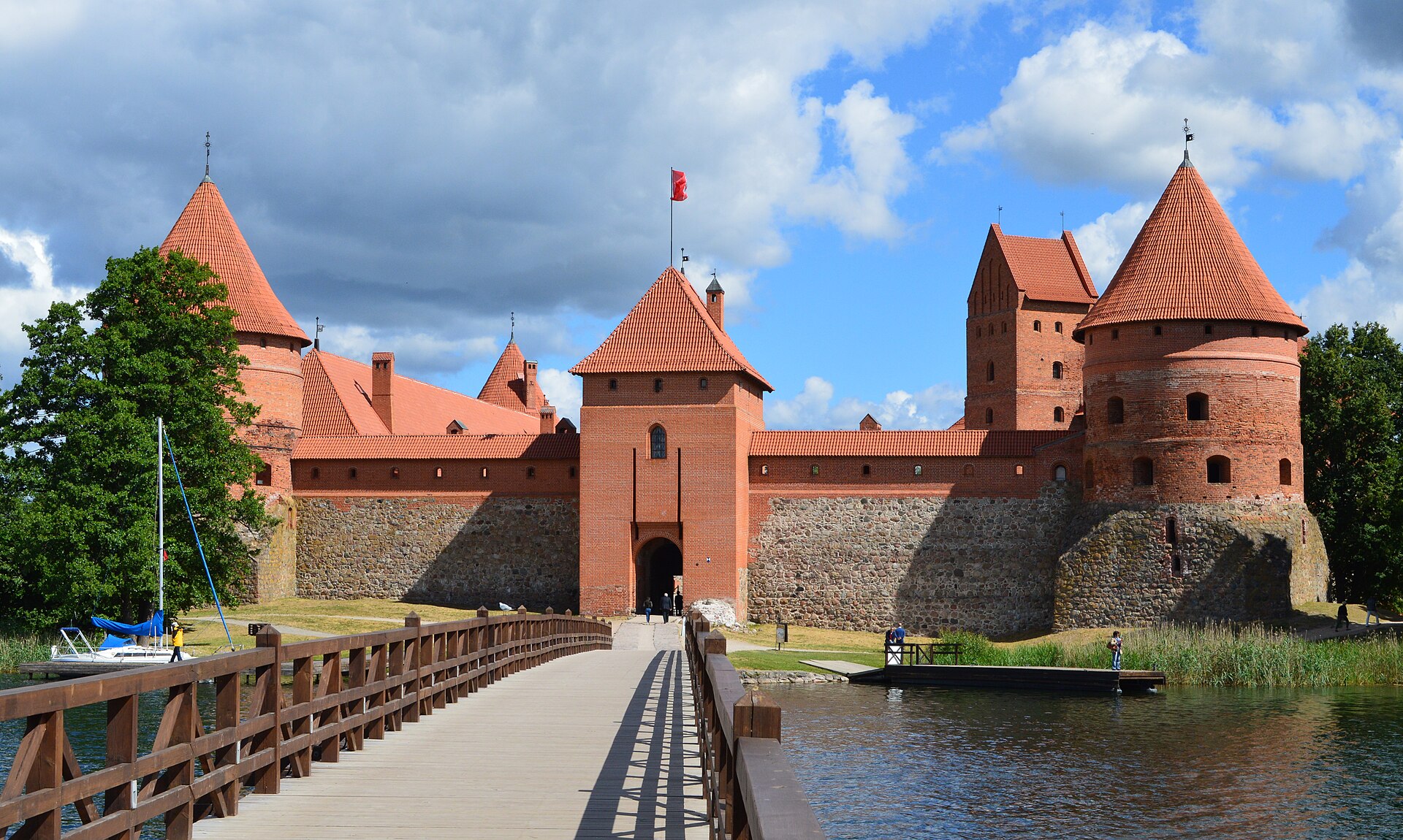
Trakai Island Castle, a seat of the Gediminid dukes on Lake Galvė.
Wikimedia Commons · File:Trakai Island 11.jpg · Photo by Scotch Mist · CC BY-SA 4.0
Prehistory and the Balts
The first people walked into this country in the later centuries of the 10th millennium BC, after the last Ice Age pulled its glaciers back. They likely came from the Jutland Peninsula and from what is now Poland, and they left their cultures in tools and camp debris. They were nomadic hunters at first. In the 8th millennium BC the climate warmed, the forests thickened, and communities settled into hunting, gathering, and fishing closer to home.
By the 6th and 5th millennia BC there are signs of domestication and more durable dwellings — families staying put. Agriculture arrived only in the 3rd millennium BC. The climate and the soil were ungenerous, and tools were scarce.
Speakers of a north-western Indo-European tongue came with the Corded Ware culture around 3200–3100 BC. The Balts, ancestors of the Lithuanians, belong to that lineage. For centuries the Baltic tribes traded only fitfully with Rome, and later with Scandinavians in the Viking age. They sat mostly off the great European routes.
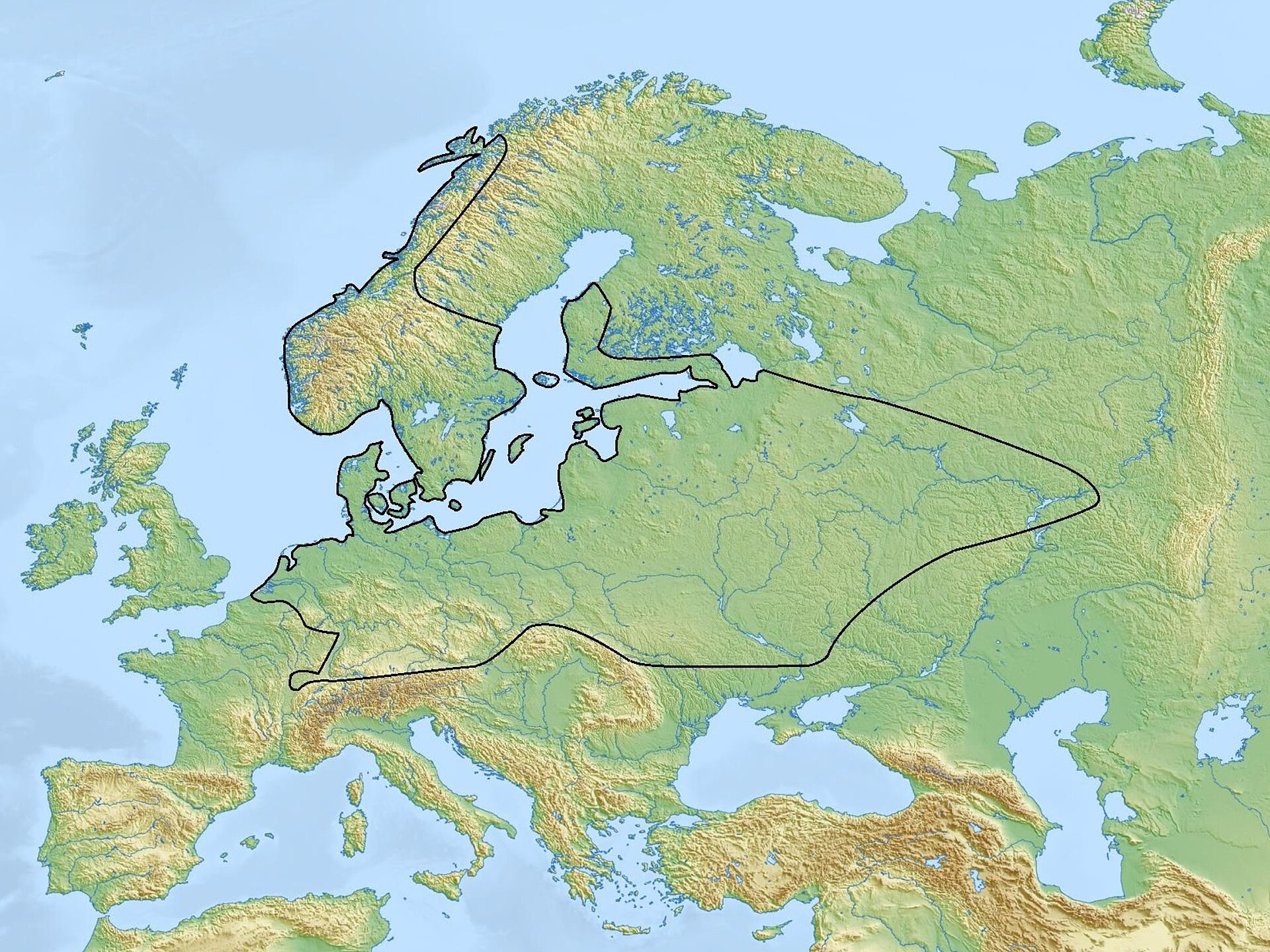
The spread of the Corded Ware culture, c. 3200–2300 BC — the world the Baltic tribes grew from.
Wikimedia Commons · File:Corded Ware culture.jpg · Map by Krakkos · CC BY-SA 4.0
The last pagans
Lithuanian religion was a reverence for nature and for the dead. It lasted into the 14th century. Among the peoples of Europe, the Lithuanians were among the last to take baptism. The pull of the old rites never quite vanished; midsummer fires and folk custom still carry a pagan thread.
By the 10th and 11th centuries local principalities were in place. In 1236 they were gathered under Prince Mindaugas, under pressure from German crusaders who had taken root on the Baltic — Riga was founded in 1201 — and who now threatened the Lithuanian heartland. Mindaugas converted in 1251 and was crowned king with the pope’s sanction. He later returned to the old gods. Baptism and kingship had not yet put the ancestral cult to rest.
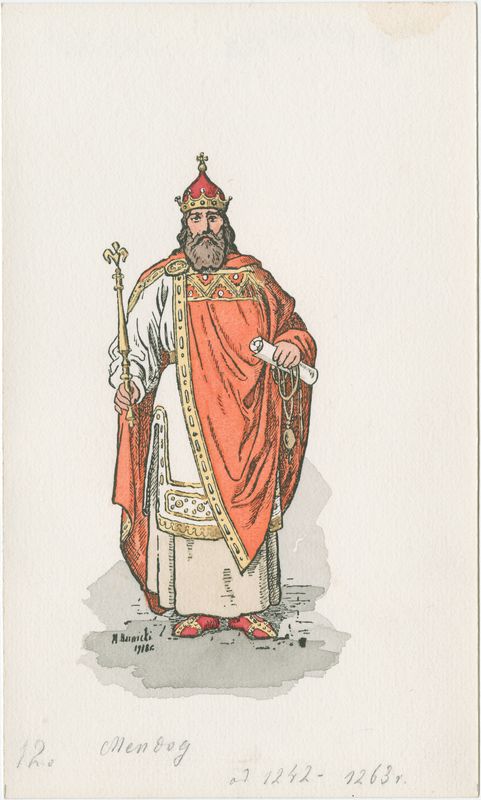
Mindaugas, first and only crowned king of Lithuania. Imagined portrait by Mieczysław Barwicki, 1908.
Wikimedia Commons · File:Mindoŭh. Міндоўг (M. Barvicki, 1908).jpg.jpg) · Mieczysław Barwicki · Public domain
Gediminas
Toward the end of the 13th century several princes enlarged the realm. Eastward expansion on a grand scale belongs to Grand Duke Gediminas, who ruled from 1316 to 1341. He did not convert, but he tried to end Lithuania’s isolation by inviting merchants, craftsmen, and monks to Vilnius. Tradition makes him the founder of the capital; by 1323 at the latest, Vilnius was already the seat of power.
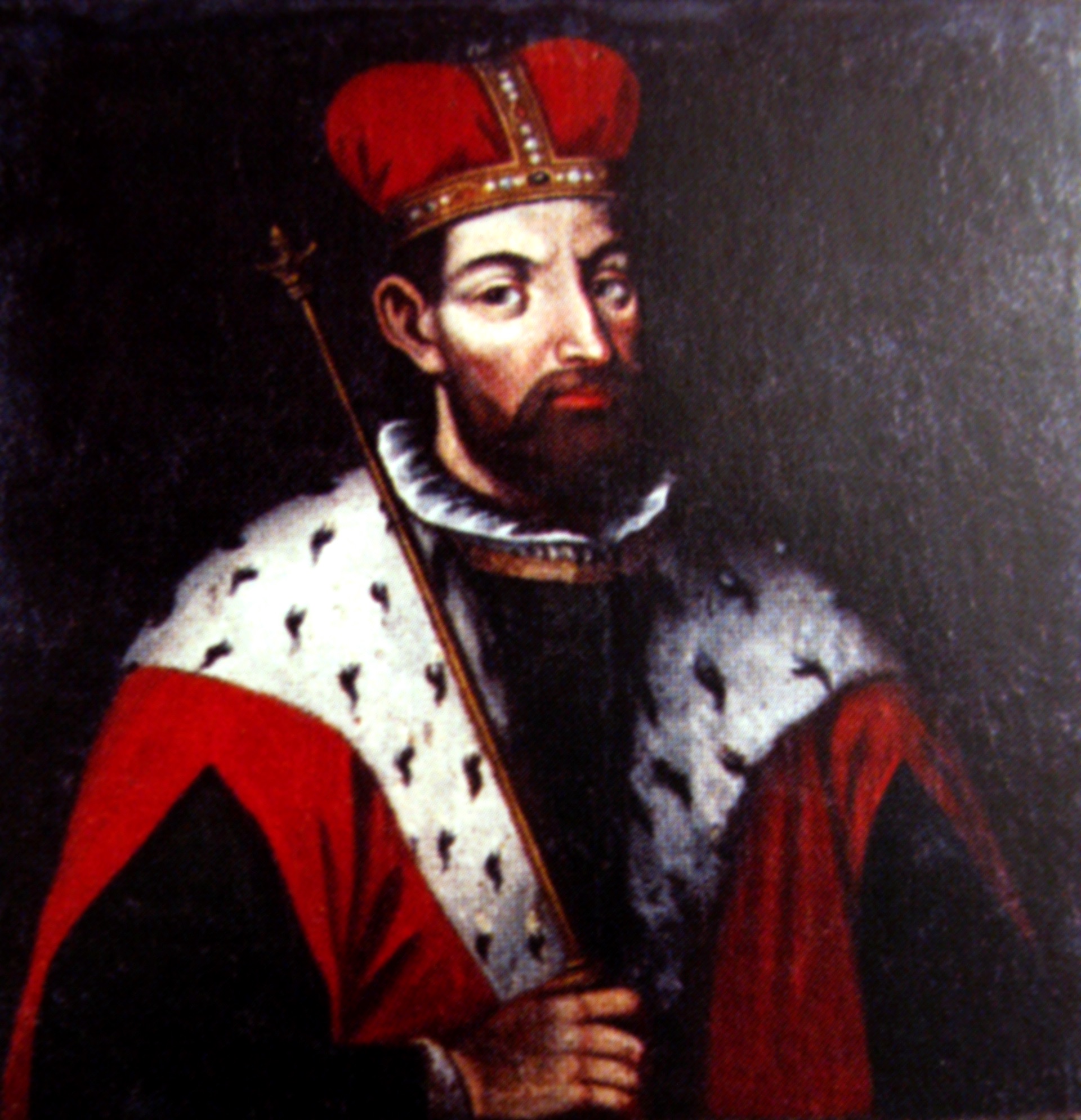
Gediminas, Grand Duke of Lithuania, in an anonymous portrait of 1709.
Wikimedia Commons · File:Gediminas, the Grand Duke of Lithuania, painted in 1709.png · Anonymous · Public domain
He left a vast country of Lithuanians and Slavs, including much of today’s Belarus. There were too few Lithuanians to colonize it. Warriors married into local noble houses and often took Orthodox Christianity.
The realm was divided among seven sons. Two kept the core: Algirdas in Vilnius and Kęstutis at Trakai. Algirdas pushed east, taking Kiev in 1362. After his death in 1382 his son Jogaila fought Kęstutis and Kęstutis’s son Vytautas. Some eastern nobles wanted Moscow as an ally. Catholic Poland looked the stronger bet.
Grunwald
In 1386 Jogaila was baptised and married Queen Jadwiga. The union of Poland and Lithuania was at first a personal one — two states, one dynasty — and it lasted in that form until 1569. Crowned Władysław II of Poland, Jogaila could not easily rule both. In 1392 his cousin Vytautas received the government of Lithuania.
For years both countries had fought the Teutonic Knights. The struggle came to a head in 1410 at Grunwald, also called Tannenberg, one of the great battles of the medieval west. Some 40,000 Poles and Lithuanians met about 30,000 of the Order. Jagiełło and Vytautas feigned a retreat, drew the Knights on, and struck with heavy cavalry. The Order’s eastward drive broke. Its decline began on that field.
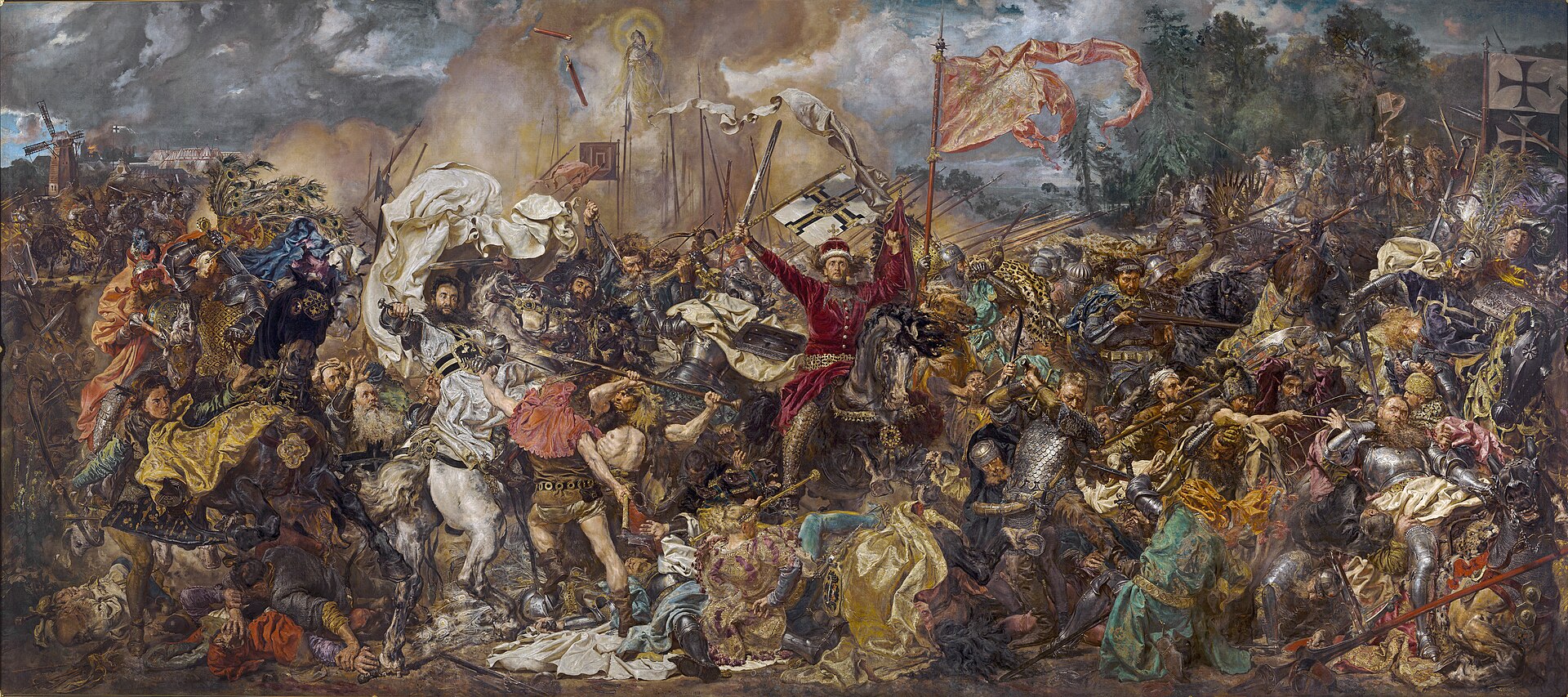
Jan Matejko’s Battle of Grunwald (1878): Jagiełło and Vytautas break the Teutonic Order.
Wikimedia Commons · File:Jan Matejko, Bitwa pod Grunwaldem.jpg · Jan Matejko · Public domain
Vytautas the Great
Under Vytautas — Witold, “the Great” — Lithuania became one of the largest states in Europe: present-day Belarus, most of Ukraine, and land toward Smolensk. In 1422 Samogitia was taken back from the Order. When Vytautas died in 1430 the duchy stretched from the Baltic to the Black Sea.
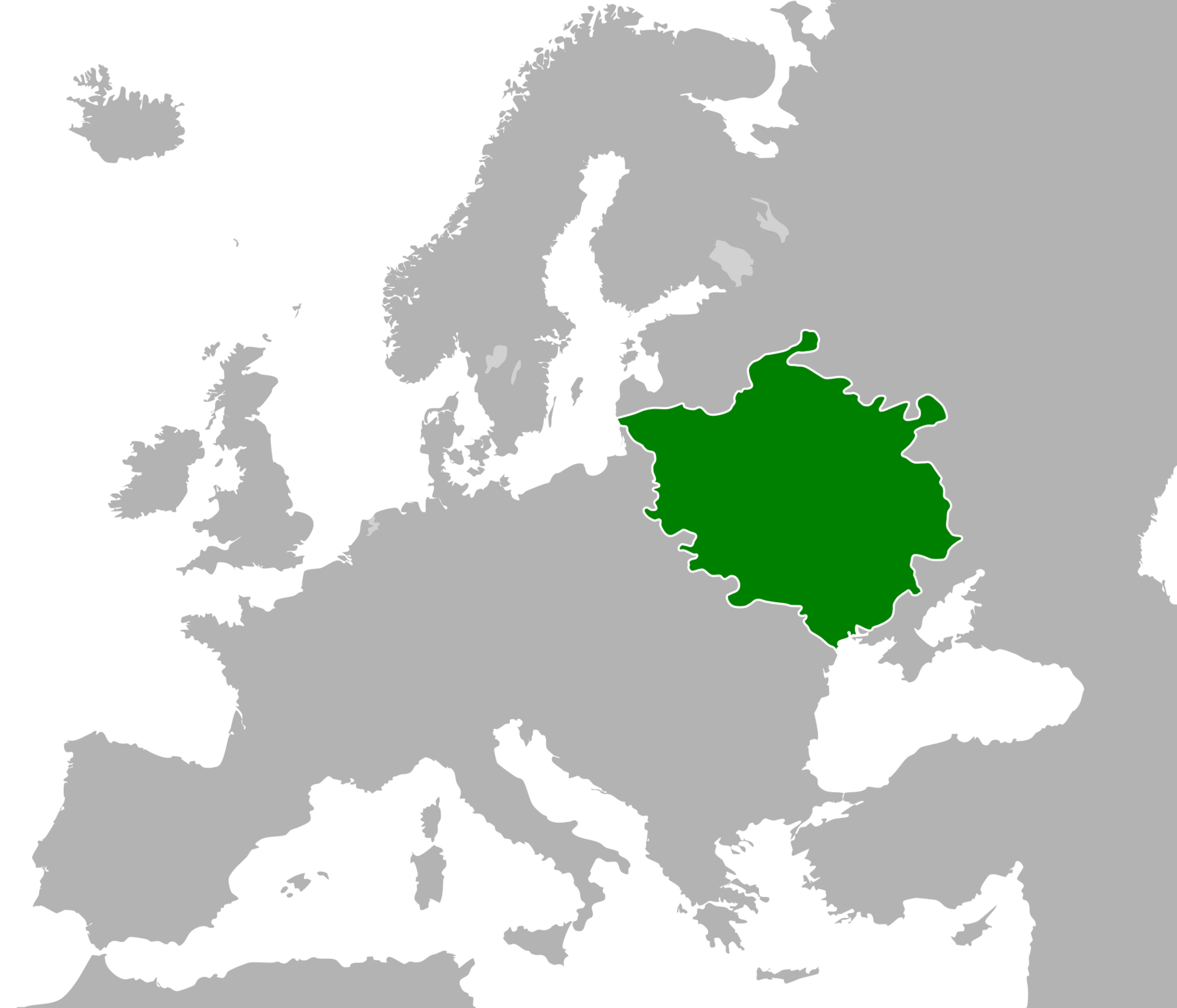
The Grand Duchy of Lithuania at its greatest extent, 1430.
Wikimedia Commons · File:Grand Duchy of Lithuania 1430.png · Map by Vaidas V · CC BY-SA 4.0
Catholicism in the 14th century turned Lithuania’s face toward western Europe. In the union Poland was the stronger partner. The Lithuanian nobility went Polish in culture and, by the end of the 17th century, the distinction had almost gone. Polish was the language of power; Latin remained at court; peasants still spoke Lithuanian, Belarusian, or Ukrainian. From the early 16th century most of them were bound to the land, and the burdens grew.
Lublin
Moscow inherited the Teutonic Order’s old role as Lithuania’s chief enemy. From around 1500 the eastern fringe of the duchy fell to the Grand Duchy of Moscow, already swelling into the Tsardom of Russia.
During the Livonian Wars of 1558–1583, Lithuania needed Polish arms. On 1 July 1569, at Lublin, the nobles accepted a real union: still a separate state, with its own laws and offices, but now a common king and a joint diet. From Lublin until the partitions at the end of the 18th century, Lithuania was treated, in politics, as part of Poland.
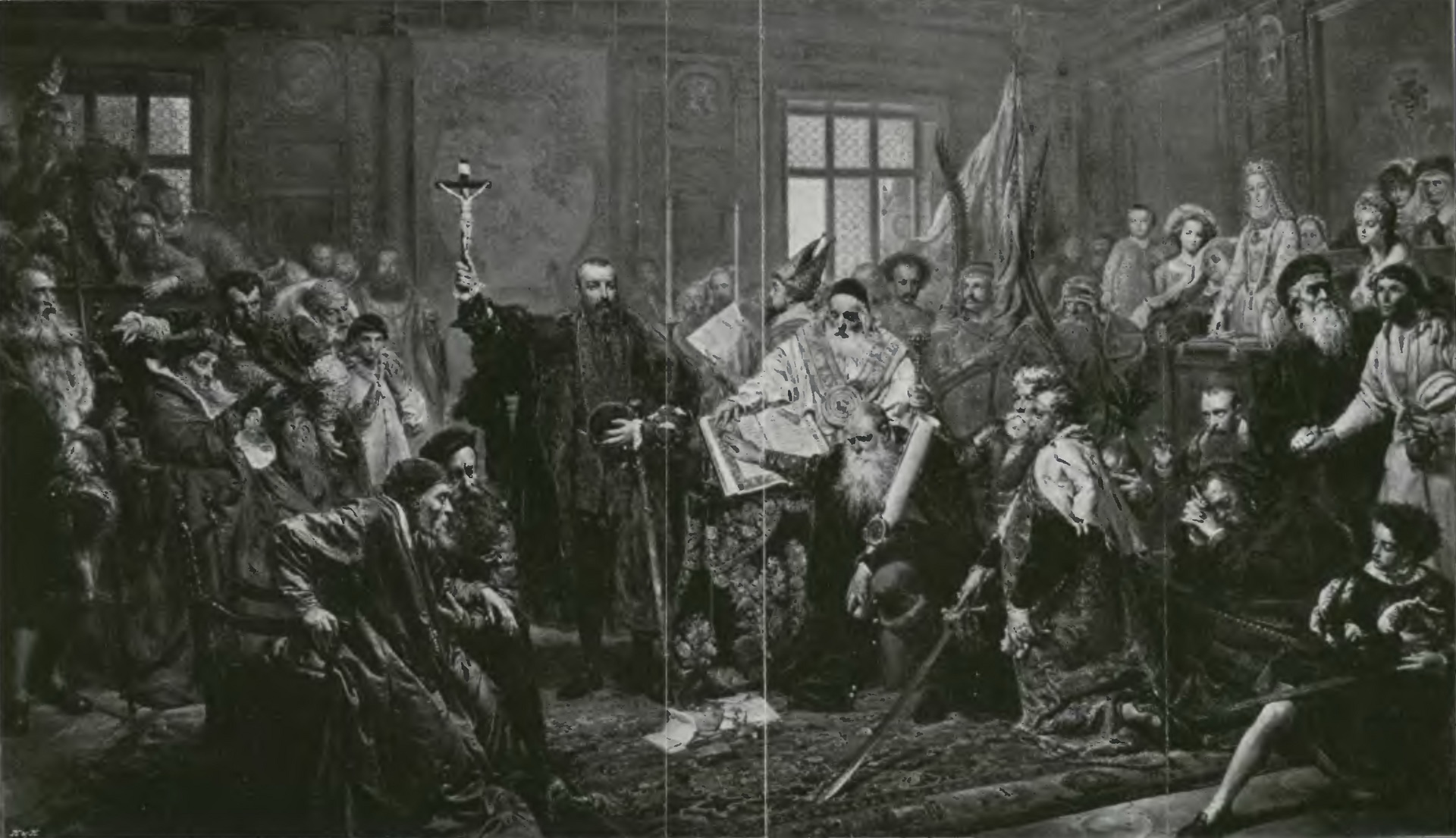
Jan Matejko’s Union of Lublin (1869): the personal union becomes a commonwealth.
Wikimedia Commons · File:Jan Matejko - Unia lubelska (1869).png.png) · Jan Matejko · Public domain
The long night
The Polish–Lithuanian Commonwealth went to pieces in three partitions. Those of 1772 and 1793 took lands mostly inhabited by East Slavs. The Third Partition, in 1795, cut the Lithuanian heartland. Most ethnic Lithuanians passed under the Russian empire; a southwestern fragment went to Prussia.
That Prussian slice later entered Napoleon’s Grand Duchy of Warsaw, then returned to Russia at the Congress of Vienna in 1815, with its own administrative habits. Serfdom ended there earlier than in the rest of Lithuania.
The Polish risings of 1830–31 and 1863 found echoes in Lithuania, and the tsar answered with Russification: the University of Vilnius closed, the Lithuanian legal code abolished, Russian and the Cyrillic alphabet forced into public life.
Resistance went underground. “Schools of the hearth” taught Lithuanian in village rooms. Books were smuggled in from East Prussia. After 1905 the press ban lifted and a Lithuanian daily appeared. The Vilnius Congress of that year asked for autonomy on ethnic lines, by the will of the people.
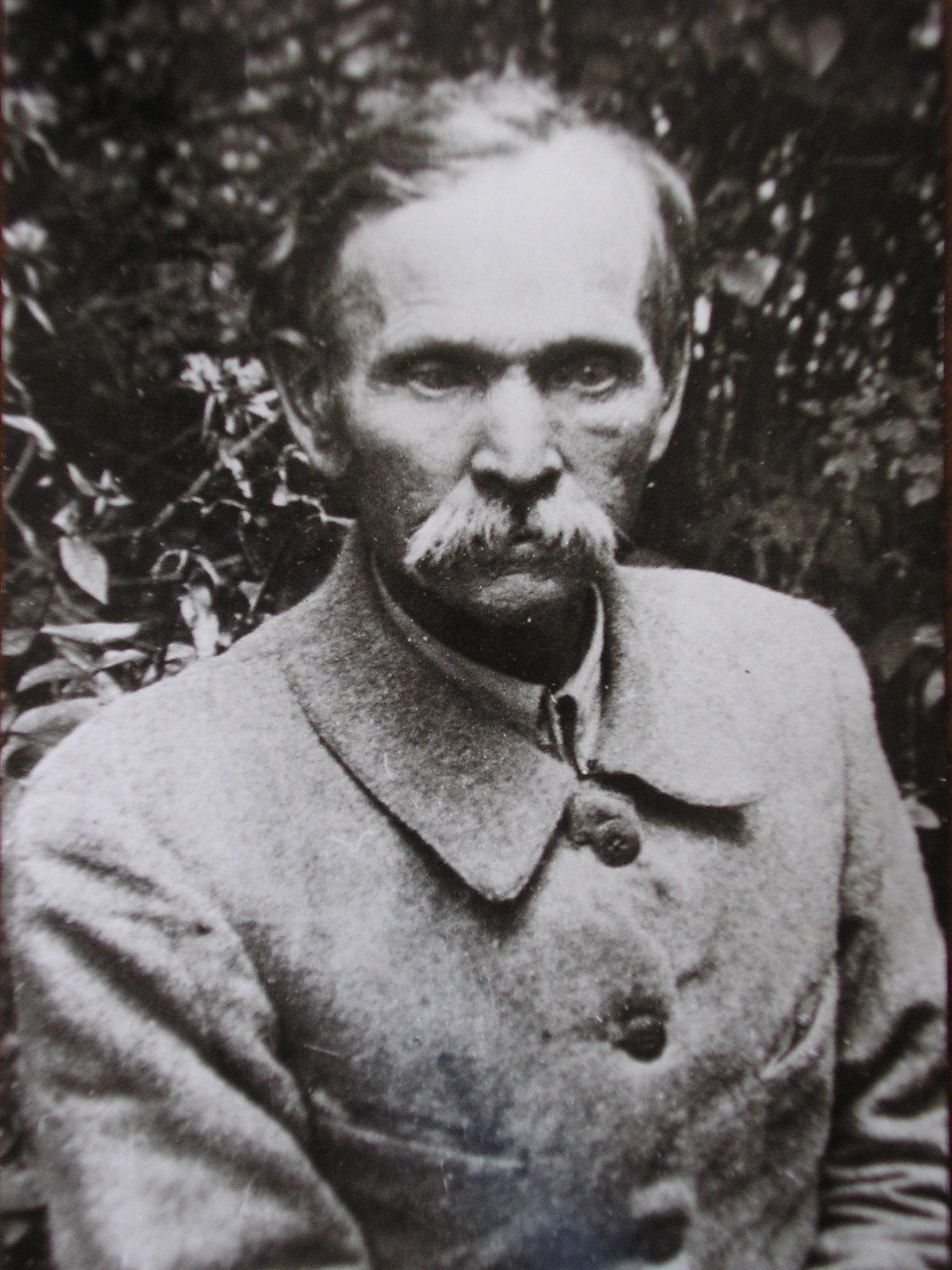
Kazys Ūdra (1857–1937), one of the knygnešiai who smuggled Lithuanian books under the press ban.
Wikimedia Commons · File:Lithuanian book carrier Kazys Ūdra (1857–1937).jpg.jpg) · Unknown photographer · Public domain
Independence and a contested map
German occupation from late 1915 was meant to produce a satellite. In September 1917, 214 delegates met in Vilnius and demanded an independent Lithuanian state within ethnic borders, with Vilnius as capital. They named a twenty-member council, the Taryba.
On 16 February 1918 the Taryba declared independence. After the November armistice the Germans left and the Red Army came. Vilnius fell on 5 January 1919. A communist government was installed; the national government fell back on Kaunas. By mid-1919 Lithuanian forces had pushed the Soviets out of much of the country.
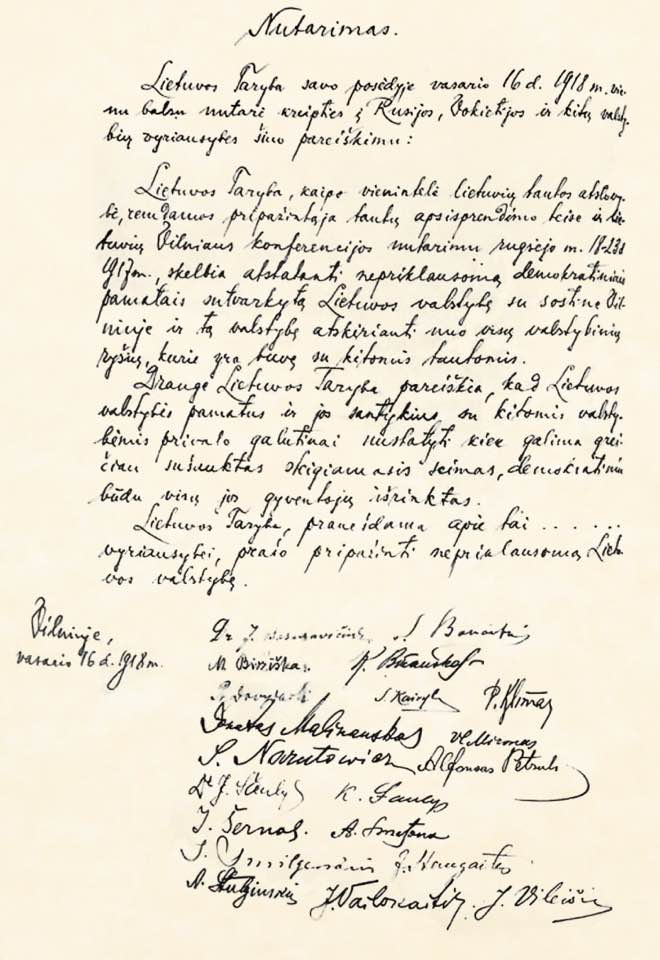
The Act of Independence of Lithuania, 16 February 1918, in the Taryba’s own hand.
Wikimedia Commons · File:Original Act of Independence of Lithuania hand-written in Lithuanian language.jpg · Council of Lithuania · Public domain
League of Nations membership in 1921 did not settle the map. Poland annexed Vilnius in 1922; Lithuania never accepted it. Klaipėda, the sea gate, was argued over with Germany until it was ceded in 1939.
At home, parliamentary democracy buckled. Antanas Smetona took power in a 1926 coup and ran an authoritarian state. A more open constitution in 1938 came too late. The next war was already approaching.
Occupations
The German–Soviet pact of 23 August 1939 hid a protocol that drew a line through the Baltics. A second protocol, on 28 September, put most of Lithuania in the Soviet sphere. On 10 October a “mutual assistance” treaty planted Soviet bases on Lithuanian soil. The compensation was Vilnius, which Soviet Russia had recognised as Lithuanian in 1920.
On 15 June 1940 Moscow issued an ultimatum and marched in. Smetona fled. Justas Paleckis was made acting president. July “elections” produced a parliament that asked to join the USSR. Annexation was dated 3 August 1940.
Sovietization followed. Some 35,000 people were deported. Then, on 22 June 1941, Germany invaded the Soviet Union. A brief Lithuanian rising against Soviet power flared and died. The Germans folded the Baltics and Belarus into the Reichskommissariat Ostland. A Lithuanian provisional government refused to serve as a collaborator administration and was dissolved. The Jewish community was almost entirely destroyed.
The second Soviet night
The Red Army was back by the end of 1944. Stalinist rule meant Russification, the crushing of independent culture, and the hunt for anyone who still thought the republic had been real.
A guerrilla war answered. At its height perhaps 40,000 Forest Brothers were in the woods, fighting into the early 1950s. Collectivization sent about 220,000 people in waves to Siberia and Central Asia.
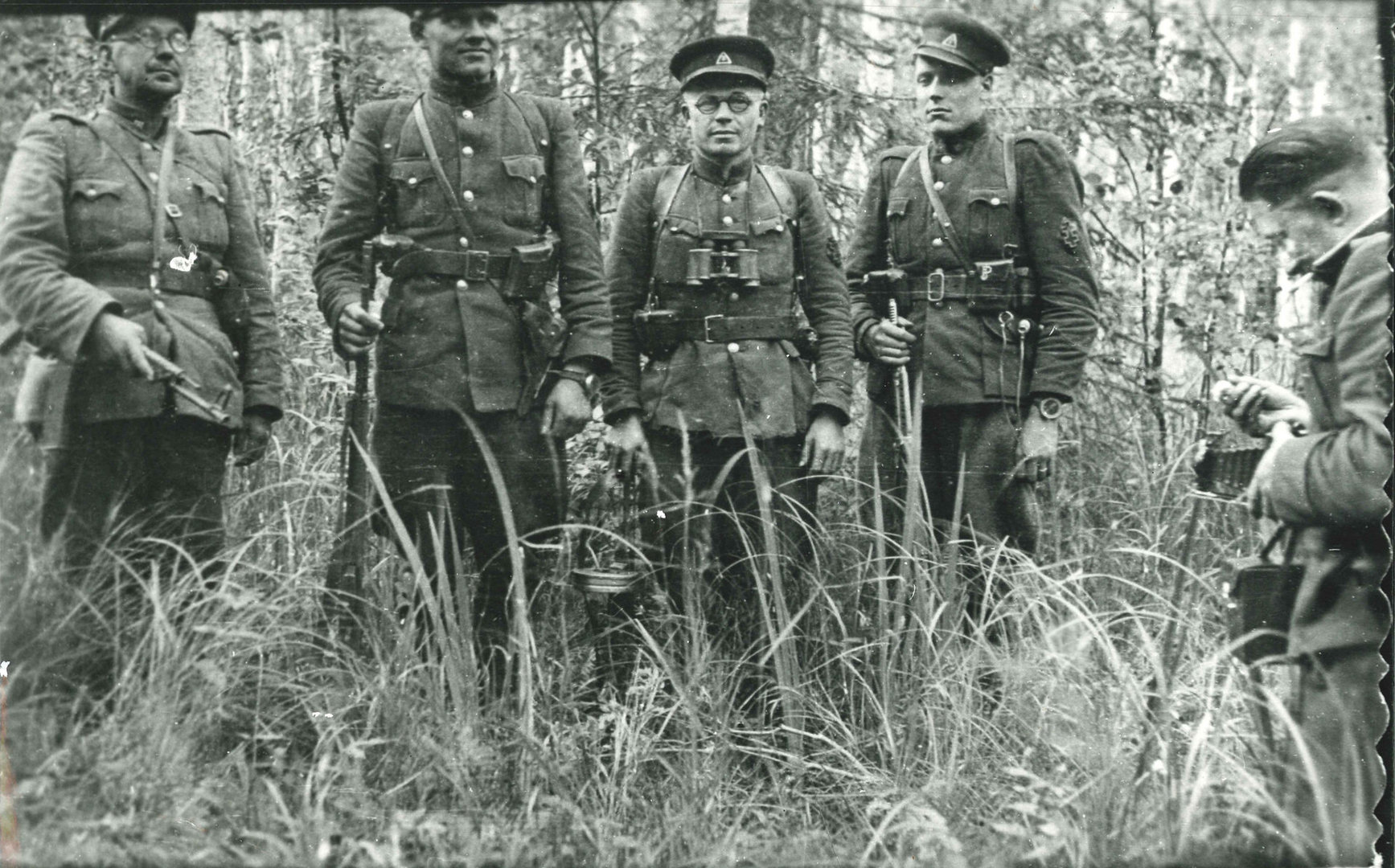
Lithuanian partisans in the forest, 1950 — the war after the war.
Wikimedia Commons · File:Lithuanian partisans photographed in forest, 1950.jpg · Unknown photographer · Public domain
A thaw in the late 1950s and early 1960s loosened the air. Under Antanas Sniečkus the Lithuanian Communist Party was gradually “nativized.” Industry and cities grew in a way that limited the inflow of labour from elsewhere in the Union. By the early 1990s Lithuanians were still about 80 percent of the population.
In the harder 1970s and early 1980s a large dissident press kept going. The Chronicle of the Lithuanian Catholic Church, begun in 1972, outlasted the regime that tried to kill it.
The Baltic Way
Gorbachev’s glasnost and perestroika — openness and restructuring — gave Lithuania Sąjūdis, a mass movement against the Soviet standstill.
On 23 August 1989, fifty years after the Molotov–Ribbentrop Pact, Estonians, Latvians, and Lithuanians joined hands in a chain some 600 kilometres long from Tallinn to Vilnius. The Baltic Way was meant to be seen.
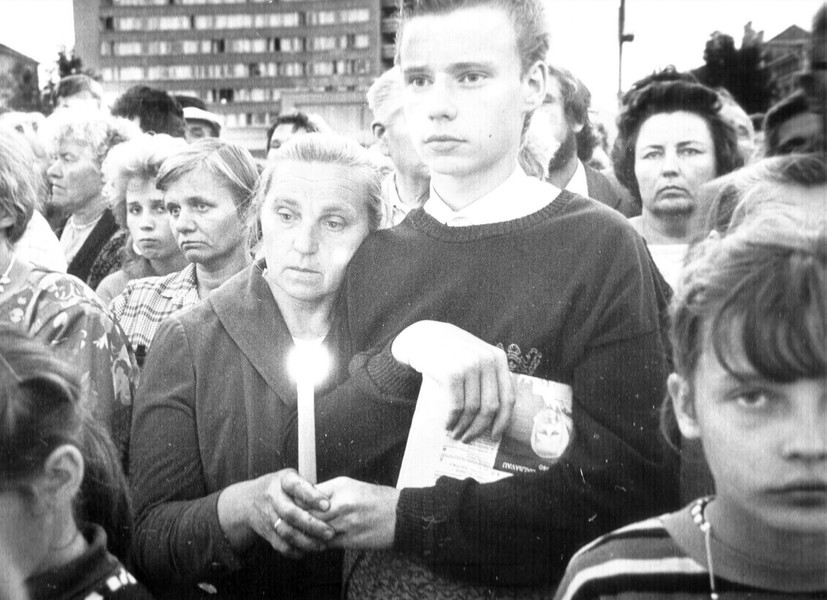
A rally in Panevėžys on 23 August 1989, the day of the Baltic Way.
Wikimedia Commons · File:Event in Panevėžys on the day of the Baltic Way.jpeg · Photo by Jonas Ambraška · CC BY-SA 4.0
Elections in 1990 returned a legislature that, on 11 March, restored independence. Moscow answered with sanctions and soldiers. On 13 January 1991 a Soviet attempt to seize back the state killed civilians and failed. The failed coup in Moscow that August opened the door to recognition. The republic was again a fact.
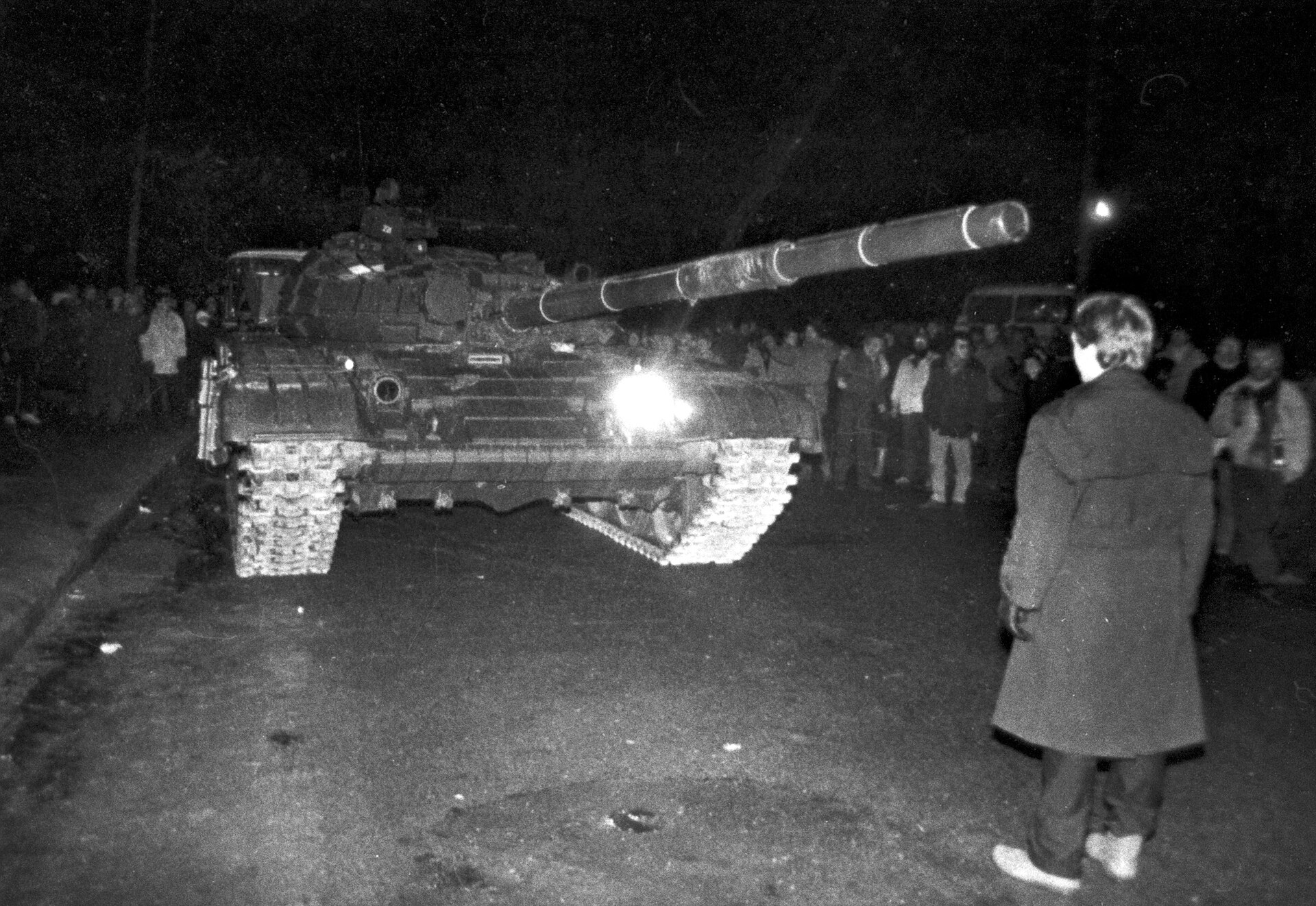
An unarmed civilian before a Soviet tank in Vilnius, 13 January 1991.
Wikimedia Commons · File:Unarmed Lithuanian citizen standing against Soviet tank, Vilnius, January 13, 1991.jpg · Andrius Petrulevičius / Lithuanian Central State Archives · CC BY 4.0
After the empire
In 1992 the former Communist Party, now the Lithuanian Democratic Labour Party, won a majority — then surprised its critics by backing market reform and a road into European institutions.
The mid-1990s were difficult: infighting, corruption charges, a weak economy. In 1998 Valdas Adamkus, campaigning on honesty, became president. Trade swung from Russia toward the west. Rolandas Paksas was impeached in 2003. Adamkus returned in 2004, the year Lithuania entered both the European Union and NATO.
EU membership was also an exit. As much as a fifth of the population went abroad for work. The 2008 crash, and a failed first bid for the euro, brought unrest. Dalia Grybauskaitė, elected in 2009 as the first woman president, pushed the recovery. Lithuania adopted the euro on 1 January 2015, last of the three Baltic states.
The country now is a small, developed republic with a talent for digital public services and a hard-won interest in energy that does not run through a single neighbour. It also lives with the cost of that openness: a drain of people, and a long, cold memory of Russia.
From a medieval great power to a nation deleted from the map, and back again: that is Lithuania’s history.
Continue on the map
Related films
Estonia · Baltic
History of Estonia
From ice-age shores to a digital republic — Estonia’s fight for sovereignty, told in one film.
Finland · Nordic
History of Finland
Lakes, two crowns, and a republic forged in winter war — the history of Finland.
Sweden · Nordic
History of Sweden
Vikings, Vasa, and a great power that learned to live without an empire.
Norway · Nordic
History of Norway
Fjords, kings, occupation, and oil — the history of Norway.